Tuesday, November 29, 2011

JAMES RYLAND - 1820 - 1902


Thanks to my cousin Kenny Ryland in Kansas, I have this lovely photo of my great-great grandfather.

One of the first things genealogists hope for in starting their research is a published biography on their ancestor from an old county history book. We all know that what we find will only be partially true, but it certainly gives us a beginning framework and it is imperative that we must prove each statement either correct or incorrect. Outrageous lies have been printed in these bios (though thankfully not in this fellow's) so early on we learn to use them merely as a theory. So let's see what this one, from the History of Noble County, Indiana, says about James Ryland:

James Ryland was born in Belmont County, Ohio, March 31, 1820. He is the son of Samuel and Hannah (Myers) Ryland, both natives of the Keystone State. They had two children - James and Matilda. They moved to Belmont County in an early day, where the father died when James was about four years of age. After her husband's death, Mrs. Ryland went to live with her parents in Wayne County, Ohio. Here she was married to Thomas Appleton, and after some years they moved to Summit County. There James was reared, receiving but a limited education. He was married to Miss Charlotte Bond, April 20, 1841. This lady was born in Genesee County, New York on December 25, 1820. In 1847, Mr. Ryland moved with his family and settled on the place he now owns in Allen Township. The land was covered with timber, but they were frugal and industrious and soon were comfortably situated. In their family were six children, viz.: Francis M., James A., George W., C. Albert and Alfred A., living, and Olive C., deceased. Francis M. went out as a private during the late war, and was promoted to a Lieutenant. Mr. Ryland owns 159 acres of well-improved land, which he and wife have obtained by their own endeavors. They are reading, intelligent people, and have given their children good educations. Four of the sons are experienced and successful school teachers.

Now just a few words to update and correct the above paragraph, 1)Though it would appear otherwise, Matilda was the older of the two children by two years; 2) James and Charlotte moved their family to Noble County, Indiana, in 1847; 3) George W. suffered a brain injury in his youth and was handicapped for the rest of his life; Alfred A died at age 31, never having been married; 4) Olive died at 1 year of age. No one has yet to discover the full story of Hannah Myers Ryland Appleton, though it hasn't been for lack of trying! She did have Appleton children, but that fact never made it into the Ryland legacy that was left for us.


This marriage record shows our James, age 21, marrying Charlotte Bond. Charlotte's father was an "exhorter" in the Methodist Episcopal Church, and James joined that church at age 18 and never changed. An interesting discovery is that in their youth I found all of James' sons held membership in the Mt. Pleasant Lutheran Church, not the ME church of their parents. James Ryland's farm abutted that of Ephraim Myers, and Ephraim was an early deacon in that Lutheran church. Since James' mother was a Myers, there may have been a family connection that drew James' boys to that denomination.

The death of old James in 1902 generated an early death certificate, showing as #59. Rarely do we find death certificates that early. Also this certificate is unusual in that Charlotte, his wife, was the informant and every single piece of information she gave is correct. It is amazing how wrong some informants' information is, but not hers.


And while early obituaries often spoke in extra-flowery language, his obit shows how he lived his life, and as near as I can tell, it shows a true measure of the man.

He commenced his life with no help but his own energy and industry. He succeeded well, educated his children, left them a legacy of sterling honesty, integrity and honor. His word was always as good as his bond. No one ever heard him profane or falsify. Among his many prominent characteristics his humaneness was striking. He would never turn anyone away from his home hungry or in need of a resting place. He has been known to entertain strangers overnight and then to remain up all night in order to guard his home from being plundered. If he found a tramp in an outbuilding he would bring him in and entertain him. He would never willingly permit a stranger to depart on Sunday. Were any of his neighbors in need at any time, they would find his best at their service. Another characteristic was his scrupulousness. He was close in his dealings, but exact and honest. On one occasion a merchant took his word as to the number of bushels in a load of corn, and was surprised later to receive money which a subsequent measurement of his wagon by Mr. Ryland showed to be due. This was the man.

Friday, November 11, 2011

JAMES ALEXANDER DOBBINS 1805-1873

~THE DOBBINS FAMILY~


James "Jim" Alexander Dobbins, oldest son of Robert B. and Catherine Alexander Dobbins, asked for and received a letter of Dismission in 1856 from his home church in Fulton, Illinois (Bennington Presbyterian Church in Ipava) and headed off somewhere with his family, according to church minutes left by his pastor father. He and his family left no family bible and no one at a Dobbins family reunion in 1911 left any notes about him. He died long before Death Certificates had come into use. Documenting his life has been hard, frustrating, and mostly unrewarding.

He had a wife, Elizabeth, and four children - Robert Gaston, Paulina Jane, Elizabeth Caroline and James Sellers. I can tell you interesting stories about all of his children, but not about him. The picture was given to me by Percy Dobbins, my dad's cousin, and it had been handed down to him from his father. At the time I received it, no one in the family even knew what his name was or anything at all about him. Even if I haven't found out much about his life, at least I now have a name for him.

Jim was the first child of Robert and Catherine, born in Ohio in 1805. His father was a circuit-riding Presbyterian minister whose territory encompassed Ohio, Indiana and Illinois. While he was out ministering, it was up to his wife and children, (predominately Jim, being the oldest) to run the family farm in Clermont county, which provided for their needs and also provided money to sustain his father's ministry.

In 1826 the Clermont County marriage books show the following:


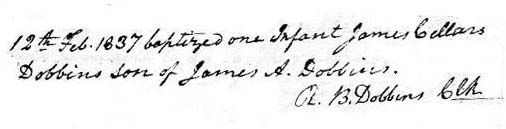
In 1835 Rev. Robert Dobbins bought acreage in Fulton County, Illinois, and he and his now-mostly married children moved there. Rev. Dobbins retired from the circuit riding but he established a local Presbyterian church, composed mostly of his own family members, and in 1837 the church records show that Jim's youngest son, James Sellers Dobbins, was baptised by his own grandfather, the Rev. R. B. Dobbins.
Those same records indicate that at two different times Jim asked for and received a request to remove the family from the church in good standing. The first time was in this same year (1837) and they were gone for four years before returning. In 1851 Jim's oldest son died. In 1856 Jim asked for and received a letter of dismission again; this was after the old Rev. died, and I'd guess Jim now felt free of the burden required of the oldest child. He took his family, just as his own father had, and traveled west, settling in the tiny town of Prairie City in Kansas, just a tinch southwest of Lawrence. No sooner did he get established there than his wife died, his oldest daughter died in childbirth, his second daughter married and headed east with her husband, and his youngest son associated himself, by his own admission, with old John Brown.

It is at this point that James Alexander Dobbins pretty much disappears off my screen. Many of the Douglas County records are missing because of all the problems that area had during the early settlement of Kansas, but it was in one recorded deed in the Douglas County Deed book that I was able to find him again. In 1871 he sold property he owned in Lawrence to the leaders of the Presbyterian Church and the deed showed he was in Maineville, Warren County, Ohio; the deed also showed he had a wife named Eliza Dobbins. A subsequent check of the marriage record showed that he had, in 1861, married the widow Eliza Gant.

Jim died in 1873. I know absolutely nothing of those final years. I have always had the feeling that this fellow, my great-great grandfather, did not have such a happy life. Too many deaths. Too many burdens. And I have always hoped that he found happiness with Eliza; nothing would make me happier than finding an obituary that said so -- but he is as remote at the end of his life as he was during it.

The one thing I have always treasured is a hand-written family chart that was sent to me many years ago by a distant relative I found back in Illinois. It is dated 1922 and is the only record I have that places James Alexander Dobbins in with the rest of the Robert B. Dobbins kids. It's not the kind of proof I would like, but I do believe it to be factual. This fancy chart was drawn then from a simple chart that had been generated at the 1911 reunion; on the older one, James Dobbins was called "Jim." So I've always felt confident that I could put my finger on the name "James" and say "He's mine!" And because of the picture, know what he looked like.

Thursday, October 20, 2011

JULIUS H. TEITELBAUM aka TITLE 1902-1974


Julius Herman Teitelbaum was the second child of Abraham and Rose Flox Teitelbaum. He was born in Chicago on November 14, 1902. He had a sister, Sarah, who was five years older than he was. His father was an insurance salesman and his mother a homemaker.

The earliest picture we have of him was taken for his Bar Mitzvah when he was thirteen. Shortly after this milestone he entered Harrison Technical High School, and with the scant information we have of him in those early years, there is nothing to indicate that he had settled on a career path yet. He graduated from High school in the spring of 1920.

By 1923 the family relocated to Los Angeles, leaving Sarah, now an adult with a job in Chicago. Julius, now called "Julie," enrolled in the USC School of Pharmacy, attending school at night and working as a clerk during the day. He received his license as a pharmacist on July 31, 1926.

The family lived in Boyle Heights, a part of the city of Los Angeles east of downtown. His first job was at W. J. Milmet Pharmacy on Brooklyn Avenue in Boyle Heights. In 1929 he was in a partnership with Lou Finklestine on Venice Boulevard (that is when he shortened his last name to Title, and his partner became Fink). He met his future wife, Bertha Mark, about that time, as she worked nearby at the Central Library in downtown Los Angeles. They married in 1928 and took their honeymoon on Catalina Island. Their son Jerry was born in 1929 and daughter Judy in 1933.


In 1932 or 1933, Julie leased a store on Wilshire Boulevard in Beverly Hills adjacent to the Fox Wilshire Theater and set up a pharmacy as a sole proprietor. He often had movie stars in his store, sitting at the soda fountain with a cup of coffee - or in the back room, where Julie let them "hide out" from their pesty fans, or occasionally to sober up!

His lease expired in 1936, and at that time he bought some property on Garey Avenue in Pomona. The family bought a house in Ontario, a small town near Pomona, and that is where the Title family lived until the children finished high school. Once the kids left high school, the family relocated to Pomona.

Although Julie was going by the name "Title" at the time his son was born in 1929, he did not legally change his name until 1940. During his prime working years, Julie participated in many community activities. At one time he was President of the Pomona Valley Pharmaceutical Association and the Elks Lodge. One of his Committee assignments for the Elks was to head the "Transit Committee." In those days there were many homeless men "riding the rails." The Transit Committee, in the person of Julie, made sure that every hobo who asked for a meal was given one, along with a bus ticket to his choice of either Los Angeles or San Bernardino. It was felt that the larger cities would have more opportunities for employment. It also appears that it was a way to get these men out of Pomona! Julie also belonged to the Ontario-Pomona B'nai B'rith, the Compass Masonic Lodge 590 and also served on the board of Temple Beth Israel in Pomona.

In the mid 1960s Julie was diagnosed with Parkinson's Disease, so he leased out the big pharmacy and opened Title's Prescription Pharmacy near Pomona Valley Hospital. He was known in all of Pomona as "Doc Title," and he was able to work for 9 years after his Parkinson's diagnosis. The last few years of his life were difficult and he died on April 28, 1974 at the age of 71.


Saturday, October 8, 2011

ROGER LIVINGSTON HALL - 1869-1935


Roger Livingston Hall was the youngest child of John A. and Martha Susan Jeffries Hall. He was a brother of my great-grandmother Louise Hall.

My mother remembered little family bits about Roger -- that he lived in Oklahoma and was a senator or “somebody political,” she said. Mother’s half-cousin Verne in Kansas told me he was a doctor but mainly worked with the Indians and became very wealthy because of some tie-in with oil that the Indians owned. Those were just little bits of the story. Whether they were true or not I probably will never know. But in a story written by his daughter Martha and printed in an Osage County (OK) Historical Society publication in 1964, I read the following:
LuLu Maud Murphy [future wife of Roger] was born in Missouri and later she moved with her parents to both Kansas and California. She graduated from the Southwest institute in San Diego (now the University of Southern California) and moved to Caldwell, Kansas with her parents where she took a teaching position.

While staying with Mrs. Richmond [Nancy E.] LuLu met her youngest brother, Roger Hall, who entertained her with the stories of his life as a rider on the Chisholm Trail. They began an engagement that lasted four years while he studied at the Missouri Medical School in St. Louis (Now Washington University). He graduated in 1894 and they married in 1895.

When he made the ‘run’ in the 1893 Cherokee Strip Opening, he staked his claim on land he saw and desired while driving cattle on the Trail. It joined what was to become the town of Medford, OK. It was to a cozy house he built there that he took his bride. A country doctor’s life was hard in those early days with no hospital nearer than Wichita, Kansas. Drought and depression followed in the ‘90s, making life even more difficult. My father’s health broke, and he was forced to go to Colorado to recuperate.

Uncle Frank Frantz, the Indian Agent in Pawhuska and later Territorial governor of Oklahoma was instrumental in bringing my parents and brother, Livingston, to Osage County in 1904. In Pawhuska two more children were born – Edmund and Martha….

My father took an active part in organizing the town of Pawhuska. He built the first brick building. Instead of practicing medicine, he turned to cattle raising, and acquired a large ranch west of Pawhuska which he sold in 1917 to the Santa Fe Railroad. Later there were other ranches and farms. My father was elected to the Oklahoma State Senate in 1916.”

According to Martha’s article, all three of Roger’s children were college educated. Son Livingston served as Osage County Treasurer and died in Pawhuska in 1974. Edmund ranched with his father until Roger’s death in 1935 and then ranched in Pershing until he himself died in 1968. And daughter Martha Hall Lloyd, writer of the article, graduated from Wellesley and taught until her marriage.


Obituary from Blackwell Morning Tribune, April 24, 1935.

A descendant of Bessie Hall Richmond (Roger's other sister) sent me a photocopied portrait of John A. Hall holding his grandson Livingston, Roger’s oldest boy who was born in December of 1899.

Monday, September 12, 2011

THE FIVE ORPHANS - PART II

~ A Dobbins Family ~


Continuing with the story of the five little orphan girls, their dad was part of a very large family, and when these girls lost their parents, there were lots of aunts and uncles who stepped in to the breech and took over raising them.

By looking at census records, both the Federal Censuses which were taken every 10 years and the Kansas State censuses, which were taken in the 5th year between the federal censuses, I was able to find all the orphans.

Jemima went to live with her Uncle William and Aunt Margaret McGee Corel

Julia went to live with her Uncle James and Susanna McGee Corel

Margaret went to live with her Uncle Frank and Aunt Nancy Corel LaHay

Louisa went to live with her Uncle William and Aunt Cosby Jane Justice

Rebecca first went to live with her Uncle Jake and Aunt Olivia Corel McGee. And then when her sister Jemima married, Rebecca went to live with her. We know this latter bit of information from Agnes Hall’s manuscript…”Rebecca was married from Mama’s (Jemima’s) house.”

And as you would expect, as the orphan girls got older they married. Jemima married John Salathiel in 1861 and they ultimately settled in Montgomery County, Kansas. Julia married Willis Myers in 1864 and they settled in Labette County, Kansas. Louisa married Thomas McGee in 1867 – and eventually they settled in Hidalgo County, Texas. Rebecca married Giles Gilbert Parman sometime around 1870 (that’s a guess) and by 1880 they were in Wilson County, Kansas.

What happened to the orphan Margaret? We can only guess. She lived with my great-grandmother Nancy Corel LaHay at least until she was 19, for at that time she was enumerated with her on the 1865 census. If you’ve read my earlier post about Francois “Frank” LaHay (Nancy’s husband) you’ll remember that both he and their two children died between 1862 and 1864. In 1867 Nancy moved to town (Lawrence) and married a second time. No mention was made of Margaret. In Agnes Salathiel Hall’s manuscript, there is no mentioned of Jemima having a sister named Margaret. And since there is no marriage record in Douglas County, Kansas, of a marriage of Margaret Corel, one assumes that Margaret died.

So now there were four orphans.

But even all that is not enough of a story for a good genealogist! What I wanted to do was learn more about their lives and, if possible, find living descendants of each of them.

Here’s where I started: Agnes Salathiel Hall’s manuscript again. Finding a family history like this, even though it may not be 100% accurate, provides a great starting place to begin research and is one of the reasons why a genealogist wants to find living descendants...maybe THAT family ended up being the keeper of the family history. So as noted in the earlier portion of the orphan’s story, I had been able to locate one of Jemima's descendants who shared this manuscript with me. Because in those days the role of the wife was pretty much that of a housewife, about the best we can do is to know a little of what the husbands were doing and then think of how it affected his wife.

So what did Jemima’s husband do? During the early years he was married to Jemima, John Salathiel was active in the anti-slavery movement, was a personal friend of James H. Lane and was enumerated among John Brown’s followers. Later he served with the Kansas Militia. After the civil war the family moved to the town of Independence in Montgomery County, where they raised their children and where John Salathiel had a grocery business. Ultimately, Joe Cullen’s line, which descends from daughter Margaret Salathiel Newcomb’s line, came to California.

Julia’s marriage certificate states that she was married “at the house of Jacob McGee.” This would have been her Aunt Oliva Corel and Uncle Jake’s house. Her husband, Willis Myers, was also among the earliest residents of Douglas County. Both the Myers and the Corel names appear on the territorial census records of Douglas County pre 1860. After their marriage Willis and Julia settled in Chetopa, Labette County, where Willis also became a grocer. They had four children: Edgar Myers, Ida Myers Columbia, Alma Viroqua “Roqua” Myers Milner, and Helen Gertrude Myers Crotty. According to Julia’s obituary of 1930, the families of both Ed and Helen Gertrude lived in Nevada, MO; Roqua in Ardmore, Oklahoma, and it wasn’t clear where Ida Columbia lived. I have never found any present day descendants from Julia.

The orphan Louisa was noted in Agnes Halls ms this way: “Lida lived in Texas and died in a storm. Her married name was McGee. Her son, Robert lee McGee visited us.” Between 1984 when I started my genealogy until this last year, I hunted and hunted for Louisa, keeping in mind that the name might appear as “Lida.” It wasn’t until May of 1910 that a Corel cousin, also a genealogical researcher, was contacted by a descendant of Louisa who was able to provide all the information we had hoped for. While Louisa is listed as “Eliza” on many of the documents the family had, that same family is enumerated on the census records with a mother called “Louisa” so one assumes that she went by both names. The family settled in Hidalgo, Texas – and the descendent who contacted us lived in Florida. He provided a death certificate of “Eliza” who died of “acute pulmonary congestion” – I suspect not as a result of a storm, as the Hall manuscript stated, but then one never knows! Needless to say, I was delighted that the little orphan had finally, after a 26 year hunt, had been found.

Finally, the story of the orphan Rebecca was also sketched out in Hall’s manuscript. In 1882 Giles and Rebecca Parman and their family (Ethelyn, Sarah, George, Lloyd and Julia) set out with three other families on the Oregon Trail. These four families filed on their homesteads in 1884, and in 1885 the town of Condon was laid out. But in 1886, Rebecca (called “Betty”) died in giving birth to twins. One twin died at birth, the other at three months. Interestingly, for whatever reason, Betty’s tombstone identified her maiden name as Carl, not Corel, so when I finally located a descendant, I had to tell her that although Betty’s family may have remembered her name as Carl, her heritage will be found under Corel. There are still Parman descendants living in that area.

So now the story of the five orphan girls ends. It has always concerned me that the heritage of orphans is usually very difficult to trace, so my goal in all this research on these firls, five nieces of my great-grandma Nannie Corel LaHay Dobbins, was to make sure the story was told somewhere.

To wrap up a few loose ends, in the year 2000 I received some information from a woman in Lawrence who had for many years been keeping her eyes open for Corels and Dobbinses. This information was that the Watkins Museum in the city of Lawrence had just turned over some old burial reinterment cards to the Museum. These cards indicated the following people were among those from the old Pioneer Cemetery on Mt. Oread who had been reinterred in the big Oak Hill Cemetery, also in Lawrence. The following people had been placed in the Corel plot in Section 1, Plot 32. I have made notes as to who these people were (or who I suspected they were.)

Rebecca and John Corel – d 09 Nov 1860 (Matriarch of the family; John not known)
Margaret – died about 1865 (probably Henry’s orphan)
Henry and Nancy Corel - d about 1855 (the orphan’s parents)
William Corel – died about 1855 (the orphan’s brother)
Margaret Corel - died about 1860 (probably Margaret Corel Puckett, adult daughter of Rebecca Corel.)


I think all the Corel orphans except for the oldest, Sarah Corel Oney, are all accounted for.

Friday, September 9, 2011

FIVE LITTLE ORPHAN GIRLS

~ A DOBBINS FAMILY ~

If you look at the 1850 Federal Census in Missouri and the 1855 Territorial Census in Kansas you will see that Henry and Nancy Corel had the following children: Sarah, William, Jemima, Julia, Margaret, Louisa and Rebecca. Sarah does not appear on the 1855 census and Rebecca doesn’t appear on the 1850 census but a little more nosing around produces a marriage record in Missouri for Sarah Corel and James Oney, and in 1855 the census shows Rebecca as the last child, obviously born after 1850.

And then, here’s the next thing one sees in Douglas County, Kansas records:


In case you can’t read it clearly, it says “On this 2nd day of October, AD 1855 before me personally appeared James P Corel, and makes oath and says that according to his knowledge and belief, that the following are the names and place of residence of the heirs of Henry Corel, deceased: Jemima Corel, Julia Corel, Margaret Corel, Louisa Corel, Rebecca Corel, residence Douglas County, Kansas Territory. Sarah Jane Oney, daughter of said deceased, residence not known, and that deceased died without a will ….

OH, NO. Is mother Nancy not considered an heir? And where is the only son, William?

When I was doing my early research back in the 1980s, I had only recently learned that my paternal great-grandmother’s maiden name was Corel. I knew nothing of the family beyond what I was able to find on the censuses. Nothing was on the internet then because there was no internet. For research, you either wrote letters or hired a researcher in the area you were interested in. In place of the internet, there was one major genealogy magazine – The Genealogical Helper – and it was from putting ads in this magazine that I finally found someone else who knew something about this family.

Joe Cullen, who lived in Northern California, answered one of my queries and sent me a copy of a Family History written by his Grandmother’s sister, Agnes Salathiel Hall, back in 1929. Agnes is descended from Henry through his oldest daughter Jemima. Here’s what I learned.

Nancy Corel, Henry her husband, Will their teenaged son, and Nancy’s sister Jemima all died within a week of measles. The epidemic of measles at Lawrence was in the Kansas History I studied in school. Many died, as they did not know what it was. They survived an epidemic of smallpox and died of measles. All four of them lay dead in the house – one room – at the same time. The neighbors came in and built coffins of native walnut lumber so abundant in Kansas in an early day…. Speaking of her parents, Mama said she could still hear the hammers building the coffins. Mama was fourteen.

All of those who died in the measles epidemic were buried on Mt. Oread. Later this was vacated as a cemetery but the graves being unmarked it is likely their ashes are still there. So many years passed before it was vacated.

Genealogists learn that not everything that is remembered is accurate. Sometimes there is speculation that turns out to be not the case. Nevertheless, Henry, Nancy and William disappear from the censuses, the county has record of probating Henry’s estate, and we soon learn what happens to the children, so we have to credit Agnes’s account as fairly accurate.

With five little girls orphaned all at once, it was up to the aunts and uncles to take in the girls and raise them. Tomorrow I’ll write about what happened to the girls.

But for today I’ll finish up with an overview of the family Henry was born into.

William and Rebecca Oney Corel married in Tazewell County, Virginia in 1806 and had fourteen children: Jemima, Henry, Martha, Mary, Sarah, Margaret, Rebecca Ann, Louisa, Cosby Jane, William, James , Nancy, Emily, and Olivia. Three of the children, Martha, Sarah and Emily died in childhood. Sometime in the late 1840s the family decided to move west.

The youngest five children (William, James, Nancy, Emily and Olivia) were still living at home with the parents. The remaining children were married. All the married families except for Rebecca Ann’s came west. Again, Agnes Salathiel Hall gives us an idea of how they did it.
“Henry Corel, my mother’s father, and brothers and families [as well as William and Rebecca Corel, their parents], their stock, etc. came to Kansas. They came from Virginia by flatboat down the Ohio, Mississippi and Missouri Rivers. The boat foundered and they unloaded at Wyandotte and drove by schooner to Westport, Missouri, using ox teams. Mama was seven years old. Kansas City was not started then.

They began a homestead on Little Blue, now Kansas city’s famous Cliff Drive. But finding themselves in slave territory they moved on to Lawrence, the main seat of anti-slave activity…. Mama said she had seen a steamboat on the river at Lawrence in a time of high water. This is a disputed subject but Mama stood pat.”

Again, not everything in this description is accurate, but it is simply a recollection of someone of old family stories.

(The story of the 5 orphans to be continued)

Sunday, September 4, 2011

PAULINA JANE DOBBINS SPERRY - 1829-1857


~ DOBBINS FAMILY ~

Paulina Jane was the oldest daughter and second child of James Alexander Dobbins and his wife, Elizabeth Perkins Dobbins. She was born in Clermont County, Ohio on November 8, 1829. Following her birth were those of Elizabeth Caroline Dobbins in 1831 and James Dobbins Jr. in 1836.

Paulina's father was the oldest son of Rev. Robert B. Dobbins, a Presbyterian minister who rode circuit in Ohio, Indiana and Illinois. Because Rev. Dobbins was gone so much, Jim became the primary manager along with his mother of the Dobbins farm property. While ministering in Illinois, Robert B. bought some property near Ipava, and in 1835 the entire family moved there. It was here that Paulina grew up and where, in 1850, she married Levi S. Sperry.

In Illinois Levi and Paulina were to have two daughters. The first, Emma, was born in January of 1852, but she died eight months later and was buried in the Dobbins Cemetery. Daughter Unicia (sometimes spelled Eunice) was born on July 7, 1854.

In spring of 1856 Jim and Elizabeth Dobbins, Paulina & Levi Sperry, and Elizabeth Caroline Dobbins Kinsey, a divorced daughter of Jim and Elizabeth, joined with a Dr. Rankin and headed west, initially intending to go to Texas but stopping when they reached Douglas County, Kansas. Levi took up some land just east of the new town of Lawrence, while his in-laws and Elizabeth Caroline chose to go on to Prairie City, a tiny town southwest of Lawrence but still in Douglas County.

There are not many records left from the early Lawrence area, but in driving through Oak Hill Cemetery I found a simple record of what happened to the Sperrys.

The largest tombstone shows that Paulina Jane Sperry, Levi's wife, died on June 6, 1857 . There is a smaller tombstone that also says "Paulina Jane Sperry", but the dates show she was born on May 29, 1857 and died on June 27, 1857. Levi lost both his wife and his new baby within the first year of being in Kansas.

The death of his wife left Levi with little three-year-old Unitia. Luckily there is an extant Lawrence newpaper that announces the marriage on August 13, 1857 to Nancy Jane Anderson, the daughter of a neighbor. But it is sad to see a third tombstone in the same row in the cemetery that is Unitia's, giving the date of her death as March 26, 1865. She was 11 years old.

That was the end of Levi's relationship with the Dobbins family. Except that a few years later, in 1867, after Paulina's brother Jim Dobbins returned from the Civil War, Jim boarded at Levi and Nancy's farm, and it was there that he met the widow Nancy Corel LaHay, who upon marriage to him would become my great-grandmother.