Monday, September 12, 2011

THE FIVE ORPHANS - PART II

~ A Dobbins Family ~


Continuing with the story of the five little orphan girls, their dad was part of a very large family, and when these girls lost their parents, there were lots of aunts and uncles who stepped in to the breech and took over raising them.

By looking at census records, both the Federal Censuses which were taken every 10 years and the Kansas State censuses, which were taken in the 5th year between the federal censuses, I was able to find all the orphans.

Jemima went to live with her Uncle William and Aunt Margaret McGee Corel

Julia went to live with her Uncle James and Susanna McGee Corel

Margaret went to live with her Uncle Frank and Aunt Nancy Corel LaHay

Louisa went to live with her Uncle William and Aunt Cosby Jane Justice

Rebecca first went to live with her Uncle Jake and Aunt Olivia Corel McGee. And then when her sister Jemima married, Rebecca went to live with her. We know this latter bit of information from Agnes Hall’s manuscript…”Rebecca was married from Mama’s (Jemima’s) house.”

And as you would expect, as the orphan girls got older they married. Jemima married John Salathiel in 1861 and they ultimately settled in Montgomery County, Kansas. Julia married Willis Myers in 1864 and they settled in Labette County, Kansas. Louisa married Thomas McGee in 1867 – and eventually they settled in Hidalgo County, Texas. Rebecca married Giles Gilbert Parman sometime around 1870 (that’s a guess) and by 1880 they were in Wilson County, Kansas.

What happened to the orphan Margaret? We can only guess. She lived with my great-grandmother Nancy Corel LaHay at least until she was 19, for at that time she was enumerated with her on the 1865 census. If you’ve read my earlier post about Francois “Frank” LaHay (Nancy’s husband) you’ll remember that both he and their two children died between 1862 and 1864. In 1867 Nancy moved to town (Lawrence) and married a second time. No mention was made of Margaret. In Agnes Salathiel Hall’s manuscript, there is no mentioned of Jemima having a sister named Margaret. And since there is no marriage record in Douglas County, Kansas, of a marriage of Margaret Corel, one assumes that Margaret died.

So now there were four orphans.

But even all that is not enough of a story for a good genealogist! What I wanted to do was learn more about their lives and, if possible, find living descendants of each of them.

Here’s where I started: Agnes Salathiel Hall’s manuscript again. Finding a family history like this, even though it may not be 100% accurate, provides a great starting place to begin research and is one of the reasons why a genealogist wants to find living descendants...maybe THAT family ended up being the keeper of the family history. So as noted in the earlier portion of the orphan’s story, I had been able to locate one of Jemima's descendants who shared this manuscript with me. Because in those days the role of the wife was pretty much that of a housewife, about the best we can do is to know a little of what the husbands were doing and then think of how it affected his wife.

So what did Jemima’s husband do? During the early years he was married to Jemima, John Salathiel was active in the anti-slavery movement, was a personal friend of James H. Lane and was enumerated among John Brown’s followers. Later he served with the Kansas Militia. After the civil war the family moved to the town of Independence in Montgomery County, where they raised their children and where John Salathiel had a grocery business. Ultimately, Joe Cullen’s line, which descends from daughter Margaret Salathiel Newcomb’s line, came to California.

Julia’s marriage certificate states that she was married “at the house of Jacob McGee.” This would have been her Aunt Oliva Corel and Uncle Jake’s house. Her husband, Willis Myers, was also among the earliest residents of Douglas County. Both the Myers and the Corel names appear on the territorial census records of Douglas County pre 1860. After their marriage Willis and Julia settled in Chetopa, Labette County, where Willis also became a grocer. They had four children: Edgar Myers, Ida Myers Columbia, Alma Viroqua “Roqua” Myers Milner, and Helen Gertrude Myers Crotty. According to Julia’s obituary of 1930, the families of both Ed and Helen Gertrude lived in Nevada, MO; Roqua in Ardmore, Oklahoma, and it wasn’t clear where Ida Columbia lived. I have never found any present day descendants from Julia.

The orphan Louisa was noted in Agnes Halls ms this way: “Lida lived in Texas and died in a storm. Her married name was McGee. Her son, Robert lee McGee visited us.” Between 1984 when I started my genealogy until this last year, I hunted and hunted for Louisa, keeping in mind that the name might appear as “Lida.” It wasn’t until May of 1910 that a Corel cousin, also a genealogical researcher, was contacted by a descendant of Louisa who was able to provide all the information we had hoped for. While Louisa is listed as “Eliza” on many of the documents the family had, that same family is enumerated on the census records with a mother called “Louisa” so one assumes that she went by both names. The family settled in Hidalgo, Texas – and the descendent who contacted us lived in Florida. He provided a death certificate of “Eliza” who died of “acute pulmonary congestion” – I suspect not as a result of a storm, as the Hall manuscript stated, but then one never knows! Needless to say, I was delighted that the little orphan had finally, after a 26 year hunt, had been found.

Finally, the story of the orphan Rebecca was also sketched out in Hall’s manuscript. In 1882 Giles and Rebecca Parman and their family (Ethelyn, Sarah, George, Lloyd and Julia) set out with three other families on the Oregon Trail. These four families filed on their homesteads in 1884, and in 1885 the town of Condon was laid out. But in 1886, Rebecca (called “Betty”) died in giving birth to twins. One twin died at birth, the other at three months. Interestingly, for whatever reason, Betty’s tombstone identified her maiden name as Carl, not Corel, so when I finally located a descendant, I had to tell her that although Betty’s family may have remembered her name as Carl, her heritage will be found under Corel. There are still Parman descendants living in that area.

So now the story of the five orphan girls ends. It has always concerned me that the heritage of orphans is usually very difficult to trace, so my goal in all this research on these firls, five nieces of my great-grandma Nannie Corel LaHay Dobbins, was to make sure the story was told somewhere.

To wrap up a few loose ends, in the year 2000 I received some information from a woman in Lawrence who had for many years been keeping her eyes open for Corels and Dobbinses. This information was that the Watkins Museum in the city of Lawrence had just turned over some old burial reinterment cards to the Museum. These cards indicated the following people were among those from the old Pioneer Cemetery on Mt. Oread who had been reinterred in the big Oak Hill Cemetery, also in Lawrence. The following people had been placed in the Corel plot in Section 1, Plot 32. I have made notes as to who these people were (or who I suspected they were.)

Rebecca and John Corel – d 09 Nov 1860 (Matriarch of the family; John not known)
Margaret – died about 1865 (probably Henry’s orphan)
Henry and Nancy Corel - d about 1855 (the orphan’s parents)
William Corel – died about 1855 (the orphan’s brother)
Margaret Corel - died about 1860 (probably Margaret Corel Puckett, adult daughter of Rebecca Corel.)


I think all the Corel orphans except for the oldest, Sarah Corel Oney, are all accounted for.

Friday, September 9, 2011

FIVE LITTLE ORPHAN GIRLS

~ A DOBBINS FAMILY ~

If you look at the 1850 Federal Census in Missouri and the 1855 Territorial Census in Kansas you will see that Henry and Nancy Corel had the following children: Sarah, William, Jemima, Julia, Margaret, Louisa and Rebecca. Sarah does not appear on the 1855 census and Rebecca doesn’t appear on the 1850 census but a little more nosing around produces a marriage record in Missouri for Sarah Corel and James Oney, and in 1855 the census shows Rebecca as the last child, obviously born after 1850.

And then, here’s the next thing one sees in Douglas County, Kansas records:


In case you can’t read it clearly, it says “On this 2nd day of October, AD 1855 before me personally appeared James P Corel, and makes oath and says that according to his knowledge and belief, that the following are the names and place of residence of the heirs of Henry Corel, deceased: Jemima Corel, Julia Corel, Margaret Corel, Louisa Corel, Rebecca Corel, residence Douglas County, Kansas Territory. Sarah Jane Oney, daughter of said deceased, residence not known, and that deceased died without a will ….

OH, NO. Is mother Nancy not considered an heir? And where is the only son, William?

When I was doing my early research back in the 1980s, I had only recently learned that my paternal great-grandmother’s maiden name was Corel. I knew nothing of the family beyond what I was able to find on the censuses. Nothing was on the internet then because there was no internet. For research, you either wrote letters or hired a researcher in the area you were interested in. In place of the internet, there was one major genealogy magazine – The Genealogical Helper – and it was from putting ads in this magazine that I finally found someone else who knew something about this family.

Joe Cullen, who lived in Northern California, answered one of my queries and sent me a copy of a Family History written by his Grandmother’s sister, Agnes Salathiel Hall, back in 1929. Agnes is descended from Henry through his oldest daughter Jemima. Here’s what I learned.

Nancy Corel, Henry her husband, Will their teenaged son, and Nancy’s sister Jemima all died within a week of measles. The epidemic of measles at Lawrence was in the Kansas History I studied in school. Many died, as they did not know what it was. They survived an epidemic of smallpox and died of measles. All four of them lay dead in the house – one room – at the same time. The neighbors came in and built coffins of native walnut lumber so abundant in Kansas in an early day…. Speaking of her parents, Mama said she could still hear the hammers building the coffins. Mama was fourteen.

All of those who died in the measles epidemic were buried on Mt. Oread. Later this was vacated as a cemetery but the graves being unmarked it is likely their ashes are still there. So many years passed before it was vacated.

Genealogists learn that not everything that is remembered is accurate. Sometimes there is speculation that turns out to be not the case. Nevertheless, Henry, Nancy and William disappear from the censuses, the county has record of probating Henry’s estate, and we soon learn what happens to the children, so we have to credit Agnes’s account as fairly accurate.

With five little girls orphaned all at once, it was up to the aunts and uncles to take in the girls and raise them. Tomorrow I’ll write about what happened to the girls.

But for today I’ll finish up with an overview of the family Henry was born into.

William and Rebecca Oney Corel married in Tazewell County, Virginia in 1806 and had fourteen children: Jemima, Henry, Martha, Mary, Sarah, Margaret, Rebecca Ann, Louisa, Cosby Jane, William, James , Nancy, Emily, and Olivia. Three of the children, Martha, Sarah and Emily died in childhood. Sometime in the late 1840s the family decided to move west.

The youngest five children (William, James, Nancy, Emily and Olivia) were still living at home with the parents. The remaining children were married. All the married families except for Rebecca Ann’s came west. Again, Agnes Salathiel Hall gives us an idea of how they did it.
“Henry Corel, my mother’s father, and brothers and families [as well as William and Rebecca Corel, their parents], their stock, etc. came to Kansas. They came from Virginia by flatboat down the Ohio, Mississippi and Missouri Rivers. The boat foundered and they unloaded at Wyandotte and drove by schooner to Westport, Missouri, using ox teams. Mama was seven years old. Kansas City was not started then.

They began a homestead on Little Blue, now Kansas city’s famous Cliff Drive. But finding themselves in slave territory they moved on to Lawrence, the main seat of anti-slave activity…. Mama said she had seen a steamboat on the river at Lawrence in a time of high water. This is a disputed subject but Mama stood pat.”

Again, not everything in this description is accurate, but it is simply a recollection of someone of old family stories.

(The story of the 5 orphans to be continued)

Sunday, September 4, 2011

PAULINA JANE DOBBINS SPERRY - 1829-1857


~ DOBBINS FAMILY ~

Paulina Jane was the oldest daughter and second child of James Alexander Dobbins and his wife, Elizabeth Perkins Dobbins. She was born in Clermont County, Ohio on November 8, 1829. Following her birth were those of Elizabeth Caroline Dobbins in 1831 and James Dobbins Jr. in 1836.

Paulina's father was the oldest son of Rev. Robert B. Dobbins, a Presbyterian minister who rode circuit in Ohio, Indiana and Illinois. Because Rev. Dobbins was gone so much, Jim became the primary manager along with his mother of the Dobbins farm property. While ministering in Illinois, Robert B. bought some property near Ipava, and in 1835 the entire family moved there. It was here that Paulina grew up and where, in 1850, she married Levi S. Sperry.

In Illinois Levi and Paulina were to have two daughters. The first, Emma, was born in January of 1852, but she died eight months later and was buried in the Dobbins Cemetery. Daughter Unicia (sometimes spelled Eunice) was born on July 7, 1854.

In spring of 1856 Jim and Elizabeth Dobbins, Paulina & Levi Sperry, and Elizabeth Caroline Dobbins Kinsey, a divorced daughter of Jim and Elizabeth, joined with a Dr. Rankin and headed west, initially intending to go to Texas but stopping when they reached Douglas County, Kansas. Levi took up some land just east of the new town of Lawrence, while his in-laws and Elizabeth Caroline chose to go on to Prairie City, a tiny town southwest of Lawrence but still in Douglas County.

There are not many records left from the early Lawrence area, but in driving through Oak Hill Cemetery I found a simple record of what happened to the Sperrys.

The largest tombstone shows that Paulina Jane Sperry, Levi's wife, died on June 6, 1857 . There is a smaller tombstone that also says "Paulina Jane Sperry", but the dates show she was born on May 29, 1857 and died on June 27, 1857. Levi lost both his wife and his new baby within the first year of being in Kansas.

The death of his wife left Levi with little three-year-old Unitia. Luckily there is an extant Lawrence newpaper that announces the marriage on August 13, 1857 to Nancy Jane Anderson, the daughter of a neighbor. But it is sad to see a third tombstone in the same row in the cemetery that is Unitia's, giving the date of her death as March 26, 1865. She was 11 years old.

That was the end of Levi's relationship with the Dobbins family. Except that a few years later, in 1867, after Paulina's brother Jim Dobbins returned from the Civil War, Jim boarded at Levi and Nancy's farm, and it was there that he met the widow Nancy Corel LaHay, who upon marriage to him would become my great-grandmother.


Wednesday, August 31, 2011

SOPHRONIA STEVENS HURLBUT 1824-1887

~ Ryland family ~

Sophronia Stevens, born in 1824 in Almond, New York, was a sister of my great-great grandpa Chester Dana Stevens. Often researchers have a difficult time finding information about the distaff side of their families, but by virtue of Sophronia’s marriage to Stephen A. Hurlbut and her own father’s exploits, she has left a bigger footprint than the usual woman does.

Her father was George Stevens, for whom Stevens Point, Wisconsin is named. Her husband was first an attorney and later was appointed a Brigadier General by Abraham Lincoln. The town both families lived in was Belvidere, Illinois, a “Yankee village, settled largely by New Englanders. The settlers, for the most part, averaged high in intelligence and culture. There were cheerful homes and genuine hospitality.”

On May 13, 1847 Sophronia married Steven Hurlbut. She was described as a charming and stately woman who was to be entirely at home in the distinguished future her husband was building. On June 7, the Illinois 2nd Constitutional Convention was held at Springfield and Hurlbut was elected a delegate. This convention was of major importance in his life as it marked his introduction into state politics.

Lincoln and Hurlbut were great personal friends. In 1855 Hurlbut organized the Boone Rifles, a Military Company and he became a Captain. In 1858 Hurlbut was elected State Representative, and he and his wife went to Springfield. In 1860 he was re-elected to this office. Lincoln was now President. During the fall of 1860, he was sent to Charleston, ostensibly to visit his sister but it was actually to discover how much Union sentiment existed in the South and how best to appeal to it. His report when he returned to Washington was “Nothing to appeal to.” He was serving in the Illinois state legislature when shots were fired on Fort Sumter. He was quickly appointed to Brigadier General of Volunteers by Abraham Lincoln on June 14, 1861.

Many letters still exist between Lincoln and Hurlbut. And as a matter of fact, Brown University has one that Lincoln wrote to Sophronia. I have been unable to get a copy of the handwritten letter but in the Collected Works of Abraham Lincoln, Volume 4, it provides the contents:


To Mrs. Stephen A. Hurlbut

Mrs. S. A. Hurlbutt Springfield, Ills.,
My dear Madam Oct. 29, 1860

Your good husband, who is making speeches for us in this county, has desired me to write you that he is well, which I take great pleasure in doing. I will add, too, that he is rendering us very efficient service. Yours very truly A. LINCOLN

Hurlbut took full advantage of his political connections throughout the war, leading to many difficulties. On September 17th, 1862, most likely through political connections, Hurlbut was promoted to major general, before his military career even began. Hurlbut commanded the 4th Division of the Army of the Tennessee at Shiloh and Corinth, after which he commanded the XVI Corps. In 1864, he was placed in command of the Department of the Gulf. While in this role, Hurlbut tried to further his own position, and caused problems with the government, which had been set up by the North to run Louisiana after Confederate soldiers were forced out of the area. His action brought forth an order from E. R. S. Canby for his arrest, but the case was quieted, and Hurlbut was mustered out of the army on June 20, 1865.

In the summer of 1866 Hurlbut resumed his law practice and started building a large and handsome house on the street now named for him. The house was demolished in the 1930s, but copies of newspaper articles showing the house can provide pictures of it.


Although the newspapers of Belvidere reported only good news about Hurlbut, his career both during and after the civil war was fraught with controversy including harassment of the loyal government of Louisiana, corruption (which had a solid foundation,) drunkenness, and embarrassment of government officials, and a local scandal that surely must have rocked Belvidere – a dalliance with one of his servants, which produced an illegitimate child.

Learning about Hurlbut’s activities give you an idea of the life of Sophronia. As you can tell, she faced many ups and downs in her married life.

Sophronia had a sister Serena Crandall, and a newspaper article from February of 1864 describes a train accident that they were in. She and her sister were riding in the last car on a mail train when a flange broke on one of the wheels at it descended down an incline. “The car in its descent turned completely over, smashing the top and sides, and landing right side up.” The list of passengers makes note of passenger injuries: Mrs. Crandall of Marengo, bruised, severe; and Mrs. S. A. Hurlbut, bruised, slight. The article indicates that it was a new car with a new type of wheels and was very valuable; it cost about twice as much as the common kind. The article ended with, “It is to be hoped the builders don’t always furnish that style of wheels.”

On February 11, 1887 Sohronia died after suffering from a lingering illness, and although it does not indicate what that was, it says that from the outset it became apparent that recovery was doubtful. Her obituary indicated she was “somewhat older than 62.” The obituary also indicates she had been a member of the Belvidere First Baptist Church for nearly 40 years.

Stephen and Sophronia had only one child, a son George Henry Hurlbut, who was born in 1848 in Belvidere, Illinois and died in New York City on February 15, 1930. George, in turn, had two sons, Stephen A., a professor of Latin and Greek at St. Albans School in Washington, and William J., who first became a Broadway playwright and in 1930 moved to Hollywood and took up screenwriting. His most famous movies were Imitation of Life and Bride of Frankenstein.Neither son married nor had offspring.

Monday, August 22, 2011

FRANCOIS E "FRANK" LAHAY - ab 1829-1862

~ DOBBINS FAMILY ~

In the scheme of things, Francois E. “Frank” LaHay lived a short life that really appears like a cipher in among a bunch of relatives. He was my great-grandmother’s first husband. They were married long enough to have two children, but unfortunately within a short period of time he died, and within a couple of years both children died. So there are no living progeny.

From a genealogical standpoint, there’s not much to document about his life, other than a few things I was able to find. But I think there is enough interesting that I should let him take his place among the Immortal Nobodies, even though we will never know what he looked like.

Frank’s father was Toussaint LaHay, and Frank had siblings Eugenie, Martha, Mary, David, and Antoine. The family appears on the 1850 census in St. Genevieve County, Missouri; all show that they were born in Missouri. The only unusual thing is that their last name appears as “Lihaise” and “Lihais.” When I first discovered “Toussaint LaHay” I was surprised to find such an Irish surname connected to the obvious French given name. To my surprise, I was to learn some years later that this LaHay line went back into Canada as Lihais and then further back into Ireland where the name was actually LaHaie. Catholic Church records were used by others to follow this line.

Apparently when Kansas territory opened up for settlement, the Toussaint LaHay family moved from St. Genevieve, to Douglas County, Kansas, where Toussaint and his three sons took a section of land on the the Wakarusa River about eight miles west of Lawrence. In a document held by the Kansas State Historical Society there is mention of the LaHay boys by the author, Henry Hiatt. “Mr. LaHay (referring to Toussaint) had a wife, two sons and two or more daughters. His boys were pro-slavery and rough and always ready to fight….Sometime in 1856 a party of free-state men…robbed his house of furniture, clothing, etc. and burned it to the ground.” The LaHays were Southerners who moved to Kansas for the same reason that the New England Emigrant Aid Society members did – to add their votes to either bring Kansas into the Union as a free or a slave state. This period of time became known as “Bloody Kansas.”

In 1853 the Corel family, originally from southwestern Virginia but more recently from Kansas City, Missouri, also moved to Douglas County. Because of the difficulties experienced in Kansas Territory during that time, only spotty records are available; there is no record of the marriage of Nancy Corel (my great-grandmother) and Frank LaHay. However, in a Civil War Widow’s Pension file held by the National Archives, Nancy writes, “I was prior to my marriage to James S. Dobbins married to Frank E. LaHay on December 19th 1856 near Lawrence, Kansas. Mr. Lahay died on February 13, 1861 (note: this affidavit was done in 1904 and Nancy misremembered the date) and was buried on his father’s place near Lawrence. Frank E. Lahay did not serve in the Army or Navy.”

About the only other records we have are three articles from the Lawrence newspapers:

Lawrence Republican, April 17, 1862: Francois LaHay, 31 years, 3 mos. Of Clinton Twp., Douglas County, died on 9th inst. In Missouri of lung fever.

Kansas Weekly Tribune, February 11, 1864: Died. Ella LaHay, daughter of Mrs. Nancy LaHay, aged 2 years 5 months, 9 days in Clinton Twp., Douglas Co., KS.

Kansas Weekly Tribune, March 3, 1864: Died. Olla (Oliver) LaHay, son of Mrs. Nancy LaHay on March 1, aged 6 years 1 month.


Skip to 1986:

In that year a researcher I’d hired in Lawrence, Kansas sent me a 1972 newspaper article that stated the following:

“The bodies from the LaHay Cemetery probably will be moved to the Clinton Cemetery by December 1, federal officials said today. The moving is necessary because the one-acre tract where several persons were buried during the last century will be covered by the waters of the Clinton Reservoir…..Federal regulations provide that all cemeteries which will be covered by waters impounded by dams must be moved – that the cemeteries not be covered by the flood waters.”

I sent to the Corps of Engineers to get their documentation for this move, and later Jerry and I took a trip back to Kansas to see for ourselves what had transpired. The original tall cemetery marker had been moved to the new cemetery. On one side it said “T. LaHay, d Mar 2, 1868, ae 68 years 2 months. And below that it says “T. LaHay reserved this acre of land during his lifetime for his family cemetery.”

On the other side it says “Frank LaHay, d Apr 9, 1863, ae 34 years.” And under Frank’s name it says “Ollie and Ella, Children of F & N LaHay.” There also is a newer flat marker that simply says “Ollie and Ella LaHay.”

That’s it for Francois “Frank” LaHay. It was a life cut short. Who will remember Frank LaHay? I know he appeared on some deeds, and his name appeared in the report prepared by a House of Representative Committee to investigate the “Troubles in Kansas”. But none of that was significant.

He was not a well-known person, nor was he recorded anywhere either for good or for bad. He left no descendants and no legacy. But he was a part of my great-grandma’s life, and even though he is not my blood relative, I want him to count somewhere. And since he’s truly an immortal nobody, here is where he shall be.


Sunday, August 7, 2011

HENRY BER KAUFMAN - 1854-1918

~ A KAUFMAN RELATIVE ~


The story of Henry Ber Kaufman is an incomplete one. What we know is gathered from little odds and ends, and there are many unanswered questions about his heritage. I guess it is often that way with orphans. Henry is not my relative nor is he my husband's. But he IS family, because Jerry was married to his granddaughter for many years until her untimely death at the age of 44. I needed to research her family line in order to give Carole a voice in the genealogy that has been so pervasive in our house these last 24 years. So here we have the family heritage of Carolyn Kaufman Title.

The picture above is of Henry Ber and his wife Caroline Gottlieb Kaufman. Shown are their first three children, Theo, Rachel (Ray), and Lewis. Later Ed, Fannie and Gertrude came along. Ed was Carole's father.

Son Lewis wrote a short family history and I'll quote from his notes: "My father, Henry Kaufman...was born in 1854 in New Orleans. During the year 1855 there was a yellow fever epidemic and both of his parents died. My father, an orphan, was adopted by a Mr. and Mrs. Ber, who had no natural children. Later Mr. Ber died, leaving the widow with the adopted son whom they had named Henry Ber Kaufman. Widow Ber, Mathilde Godchaux Ber, somewhere met widower Solomon Gottlieb and they married. So Henry Ber Kaufman, the orphan, was brought into a large Gottleib family and became 'one of the boys', being the same age as Charles Gottlieb." Apparently Mr. Gottlieb had children from an earlier marriage, so Henry fit nicely into the family.


Backing up a bit, on August 1, 1855 the Home for Jewish Widows and Orphans opened in New Orleans as a result of this yellow fever epidemic. Mr. Ber was one of the early sponsors.

In a hunt for the orphanage records I went to New Orleans, where I was able to locate these records. To my great surprise, in looking at them I found several things of note: 1) Henry's name was actually Kaufman, which means Mr. Ber did not change Henry's name when he adopted him but used Ber as Henry's middle name, 2) the "Biography 3" indicates that Henry was the third child to be placed in the orphanage, 3) Henry was admitted on August 1, although the formal record states the orphanage was opened on August 7; and 4)Henry was adopted when he was three years old.

So little Henry was one of the reasons that the orphanage was needed. There is no birth record for Him, except that the orphanage records says he was born in Louisville, Kentucky. That is more likely than the family saying he was born in New Orleans. However, I have never been able to corroborate that.

Henry did fine growing up in the Gottlieb family. Solomon had a daughter named Carrie about Henry's age, and Matilda was sure that Henry and Carrie would make a good match. The family always remembered her saying to her step-daughter Carrie, "Nuh, dare is nothing like dat Heinie." Over the years Carrie came to believe her, and she and "Heinie" (Henry) married on February 22, 1890 in Baton Rouge.

This is a picture taken in 1945 of those Kaufmans who were still living in Baton Rouge.


Henry Ber Kaufman has many descendants, four of whom are my lovely granddaughters, Stacey, Carley, Jill and Katie. The research on the Kaufman side of the family is for them.

Monday, August 1, 2011

JESSIE CLEONIA DAVIS RYLAND 1885 - 1947

~ RYLAND FAMILY ~


I didn't have either of my grandmas in my life for very long. My dad's mother, who lived in Colorado, died when I was 6, and this grandma, my mom's mother, died when I was 11. But this is how I remember her looking: very grandmotherly, I thought. She was 62 when she died, and I am now 76 and I don't think I look nearly as grandmotherly! But perhaps my own little grandchildren think so. It's hard to see oneself as old.

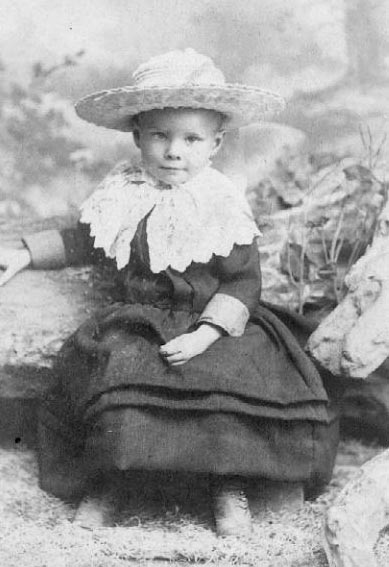
Jessie did not have the easiest of lives. Her father, Joseph Clinton Davis, deserted her mother, Nellie Stevens Davis, shortly after Jessie was born in Kansas. In 1887 her mother met James Eungard, a railroad man, and after securing a divorce, Jim and Nellie moved to Pueblo, Colorado, where they married. Sometime before this picture was taken Jessie took sick with typhoid fever and she lost all her hair. This photo has been in our family for many years and I was told that Jessie's hat covered her bald head.


As with many railroad families, the Eungard family moved from place to place, sometimes in Kansas and at least once to Oklahoma, where her stepbrother Chester Eungard was born. In 1900 the Eungard family was enumerated in Wichita, where Jessie was shown as 15 years old. By 1905, the family was in Caldwell, Kansas, where she met and married Byrd Worthington Ryland, the youngest son of James A. Ryland. In 1906 her first child, a son named Nevalyn Eugene Ryland (called Bob) was born.


She and Byrd would go on to have 6 more children besides Bob: Florence Vivian, Virginia Louise, Marie Eleanor, Byrd Worthington Jr., Hugh Sterling, and Marjorie Ellen.

There was a problem in the marriage, however. Byrd Sr. couldn't settle down. In the course of the marriage he couldn't seem to stay in one place for very long, uprooting the family while he tried to figure out what he wanted to do with his life. He apparently was not in good health and often the move was between Caldwell, Kansas, and Colorado Springs. But there was something else wrong besides that. In 1929 Jessie filed for divorce, in the Complaint noting that "Since the marriage of plaintiff and defendant, defendant has been extremely and repeatedly cruel towards plaintiff..." Later in the papers it notes that "Defendant is not a fit person to have the custody of said minor children." The divorce was granted, and instead of alimony, Jessie accepted a cash settlement and the farm property in Mulvane, Kansas.
By 1929 the three oldest children were out of high school and on their own. Grandma Jessie took the four youngest to the farm and attempted to make a go of it there. I can remember as a child being told that Jessie raised chickens and children, and loved them both. But in the picture below, a snapshot, you can see that life was not easy for her.


To make matters worse, in 1930 the farmhouse caught on fire and burned to the ground. Jessie took the children to her aunt's house in Wichita, where they stayed until she got on her feet again. About this time her son Bob, who had gone to California to become a movie star, encouraged her to come out where he could help her. Grandma asked my mother, who was in Colorado Springs working at a photography studio, to help her with the children on the trip, and in late 1930 they headed to California. I am not sure where in her life the picture below actually belongs, but I like to think that this is how she looked when she began her great California adventure, putting her divorce and her farm loss behind her.


California was in the grips of the depression like the rest of the country, and since Bob's movie career had failed to materialize, the little Ryland group - Jessie, Virginia (19), Marie (15), Bert (11), Hugh (9) and Margie (4) did their best to survive. Jessie used her settlement money to buy a little ice cream shop in North Long Beach, which failed. She then worked at a farmer's roadside vegetable stand, did some odd jobs as a live-in attendent for old people - and my mother took care of all her little siblings. The four younger children always had a very close relationship with my mother, because she was their de facto mother for those really tough depression years.

For many years various family members lived together in Long Beach in a big old house while Bert and Hugh served in WWII. Florence's husband was overseas also, and she and her baby daughter came to California for a while. As things got easier financially for the family, Grandma's cheery disposition took over and in spite of working hard each day, she went dancing at night and certainly must have captured some of her lost fun! She met and became engaged to a fellow dancer and plans were in the making for a wedding when she was felled by a heart attack at age 62 and died.

I have always felt that Grandma Jessie had a tough life. Of course I didn't know much of this when I was a kid, but being raised around all my aunts, uncles and cousins we of course knew some of it. But I will say this for the Ryland Family: None of us second generation kids ever heard a bad word spoken about our Grandpa Byrd. The siblings may have talked among themselves, but they were completely close-mouthed about family matters to their kids. All that I learned about my Grandpa Byrd, who died in 1935 just before I was born, was from my own genealogical research.

Many years later after my own mother died, I asked my dad if he knew what the problem was with Grandpa Byrd. He said my mom never would tell him. But he assured me that for his money, Jessie was the best woman he'd ever met, next to my mom, of course. He said that Jessie cried something awful when she learned that Byrd had died in Colorado. He said he figured she really, after all those years, carried a fondness in her heart for him, the father of all her children.