Friday, November 1, 2013

...AND WHERE IS THE PROOF?


In an earlier post I wrote about my great-grandma Louise.  She has always been the subject of some consternation in my extended genealogical family for several reasons:  She was a second wife, marrying a man twice her age who was widowed and had two smallish sons.  Between the time of his first wife's death and the remarriage, he had placed both boys with other families in the farm community to care for.  The present day family believes that Louise was the one who farmed the kids out.  It still makes them mad.

Another reason is that she WAS very young when she married and this didn't set well with them.  She was born in 1863 and married in 1878, which made her 15, although a few days after she married she turned 16.  Apparently she was not a perfect stepmother and tended to favor the son she had with her husband over her stepchildren ... at least if you believe the remnants of stories the present day family tells.

A third problem grew out of whether or not she wrote a book about Caldwell, Kansas.  Her husband said she did, but the present family believes, in spite of a letter to the contrary from her husband, that he himself wrote it.  This book's writing was slammed beyond belief by a local professor, and I have always wondered why the present day family wants to claim it if it is so horrible -- purple prose, this fellow calls it!

Anyway, given that this condition exists, there is also a strictly genealogical problem that has been around as long as I have been researching this family. From early on, new genealogists are told to prove every fact.  It is easy to think that a death certificate is proof, and often "newbies" use that as their proof.  But as an example, the informants who give the information put on death certificates often are simply wrong about what they put down.  They may believe it with every fiber of their being, but that still doesn't make it so.  My issue with Louise "Lou" Hall has been her birth year.

The earliest year she shows up on a Federal census is in 1870.  At that time she and her family were living in Warrensburg, Missouri.  Here is what the family looked like at that time:


1870 Census – Warrensburg, Johnson, Missouri

John A. Hall       34
Martha Hall        36
Abner Hall         12
Charles Hall       10
John Hall             9
Bessie Hall          7
Lou Hall              5
Roger Hall           1

That census showed that sister Bessie was two years older than Lou, and by deduction, Lou would have been born about 1865.  Since I had no reason to think the informant (probably either her father or mother) would be incorrect, I just assumed this was accurate.  Thus, all the research I did from that point on was predicated on the assumption that Lou was born in November of 1865.
The major problem this presented to me was that she would not have been close to 16 when she was married but rather was close to 14.  

YIKES! 

By 1880 Lou was happily married with a new baby - and at least as far as Federal Censuses go, she never again appeared enumerated within the context of her birth family.  And I didn't get around to researching her siblings for a long, long time.

However, for an entirely different reason I decided to see if her family appeared intact on the 1875 Kansas State census.  Although the name Hall did not appear in the index, (making me assume they were not in Kansas) by browsing through the various townships in Sumner County, Kansas, where I knew the family had moved, I was able to find them.  And I got a big surprise:

1875 Kansas State Census

John A. Hall    40
Martha            34
Abner             17
Charles           15
John                13
Lou                 12
Bessie             10
Roger               6

In this census, Lou and Bessie have exchanged positions; Lou appears to be the older of the two girls, making her birth be in 1863 rather than 1865.  That meant that all those other documents where her year of birth is shown as 1863 were correct.  She had NOT knocked a few years off her age like so many women did (and still do!).  Whoever in 1870 gave that bad information to the census taker (and it could have been either mom or dad OR the census taker himself!) was in error.  

I had built up a whole story that would make sense for using 1865 as a birthdate; it never occurred to me to question its veracity.  The story I fabricated made sense, but it was wrong.  Finding this new census information  solved a big problem I had, and made me once again realize how necessary it is to check and double-check what one is using for "truth."  

I do not want wrong information as a legacy of my genealogy!

Thursday, October 31, 2013

FROM LEONIDAS J. WORSLEY TO FLOTO, THE ELEPHANT

 
Posted by Picasa
So here is a sad story.  It’s a very interesting story, but still, quite sad.  It took place in Riverside, California in 1908. 

On the morning of April 16 of that year, the Sells-Floto Circus arrived in town via the railroad.  Stopping in an area just northeast of town, the area filled with people watching the circus set up.    The first event of the day was a parade of all the costumed performers, caged and uncaged animals and the circus band at the head of the line.  Into the town it went, and then it circled back to finish setting up.  Between the band and the calliope there was music everywhere, and the townsfolk were excited about this year’s event.

Sells-Floto Circus was lucky enough to have six trained elephants in their menagerie: Old Mom, Trilby, Floto, Snyder, Alice and Frieda.  In the parade they carried banners advertising local businesses. 

While it seemed like the whole city had turned out for the parade, there were still plenty of businessmen who had jobs to tend to and chores to complete.  One of these was a deliveryman who had a tank on his delivery wagon and he needed to fill it with gas.  This wagon was pulled by four horses.  His first stop of the day was at the Standard Oil Company storage yard, which was about a block southwest of the circus grounds. 

Leonidas J. Worsley, a 62 year old Civil War Veteran and resident of Riverside, was refilling his delivery tank with distillate when there was a sudden explosion and fuel shot out all over Worsley and his wagon.  Fire followed and quickly spread to the storage yard.  The blast set the horses running toward the empty lot over by the circus tents and it tossed Worsley on the ground about 20 feet away.  People nearby ran to help Worsley; about all they could do was to roll him in the dirt to put out the flames.  He was alive, but horribly burned.  He was put in a wagon and immediately was taken to County Hospital.  He died of his burns an agonizing three days later.

In the meantime, the horses were caught and separated from the burning wagon.  Some embers set a few small fires around the circus grounds but they were quickly put out.   It would still be an interesting story if this were the end of it. 

But it went on.

After the parade, two of the elephants (Old Mom and Trilby) had been put to work moving the crates and other storage items to a corner of the lot.  The four remaining elephants had been “staked to the ground in a picket line.”  The big animals sensed the danger and one by one the four elephants, “trumpeting, twirling and pulling…pulled their stakes from the ground and fled…” Hoping to find and calm the elephants, the elephant handlers took Old Mom and Trilby with them as they headed out to capture the marauding beasts.  Three of them were fairly easily caught, but Floto was enraged and he led them on a not-so-merry chase.

To make a long story short, he saw a woman alone on a front porch and he headed for her.  She tried to get inside the house, but the door was locked.  Floto lumbered up the stairs, head-butted her, picked her up with his trunk and then threw her down on the ground, after which he stomped on her.  She didn’t die then but by 9 p.m. that evening she was dead.  The elephant proceeded to run amok through the streets of downtown Riverside, trashing everything he could see.  He tore up the barbershop in the Mission Inn, destroyed a camera shop, a music shop, broke a horse’s leg, tore up fences and trees and finally found himself in a stable.  From there he was trapped.  The handlers caught up with him and after more than an hour they were able to calm him enough to lead him back to the circus grounds.

Amazingly, the circus was able to give the evening performance and the town settled back to normalcy.  The circus had an insurance representative with them and he settled all the claims, including burial costs for the lady killed by the elephant to everyone’s satisfaction.  Within a few days, the circus packed up, loaded back onto the train and chugged off to their next booked event.

End of story.

Being a good, snoopy genealogist, I have already learned what more there is to know about poor Leonidas J. Worsley, who he married, his child’s name and his grandson’s name.  I also know that he was buried in a local cemetery, although the death date on the stone is off by one year.  When my life slows down a little bit I’m going to make a trip down to that cemetery and get a snapshot of his stone to add to the Findagrave posting.

I learned about this story from a fine article researched by Aaron Maggs and Allison Maggs and published in the Journal of the Riverside Historical Society.  They did a beautiful job of documenting the tale and as I read their Notes, which is where they show their sources, as late as 1988 the story had been written up in the local newspaper.  Although this is not a “good” story, it IS an interesting one.  I wonder if many Riverside residents know about it now?

You wonder what my interest is in all this?  Aside from it being a very interesting run of events, I had a distant relative, Traber Norman Dobbins, grandson of my great-grandpa James Sellers Dobbins, who played clarinet in the Sells Floto Circus, though many years after this above episode happens.  And learning about all the traveling circuses that criss-crossed the country before the biggies of my own childhood -  Clyde Beatty, Barnum and Bailey and Ringling Brothers - did was a big surprise to me.  These circuses came by train, too, and many times before I was even a teenager I watched the circus train pull in just north of the interesection of Cherry and Pacific Coast Highway in Long Beach, California, and unload everything -- just like the Sells-Floto had been doing for years.  

Sunday, October 14, 2012

JUNIUS SLOAN - THE ARTIST

REPUBLISHED FROM HOT COFFEE & COOL JAZZ


Wednesday, October 20, 2010


CHASING A TURK - II


In researching at the Protestant cemetery in Istanbul, I found everything way too interesting, so I had to set definite parameters for the future book: AMERICANS BURIED in the Protestant Cemetery. While their families who weren't buried with them were important because I wanted that information to help link them up to a place in America, in the Pratt case I barely knew that there was such a child as Albert Pratt. I was really researching the details of his father and mother, Dr. Andrew and Sarah Goodyear Pratt, and the names of their dead children on Dr. Pratt’s tombstone were my focus. So more than 10 years later coming upon the name of one of their children who lived in Redlands, California after leaving Istanbul was, well, just a shock and too good not to continue researching! If you are a genealogist, you know that the more you need to research, the happier you get!

So in 2002 I went over to the Redlands library - Redlands being a small town next door to San Bernardino - and looked in the old Citrograph newspapers of June, 1889. Sure enough, there was a BIG article on the wedding. This wedding was the social event of the year.

Madeleine was from a well-to-do family originally from Kewanee and Chicago, Illinois. A big chunk of the Sloan family had moved to Redlands. Madeleine had lots of aunts, uncles and cousins there. Madeline’s grandfather, Seymour Sloan, had not moved here but he visited often. The newspaper, which actually has been indexed, announced that on one of those visits he died and his body was shipped back to Illinois for burial.


One of Seymour’s sons was Dr. George Sloan of Chicago who financed the building of the Sloan House in Redlands, a three-story brick hotel, which opened in 1888 with Horace, Madeleine’s father as proprietor. Another of Seymour’s sons was Junius Sloan, a well-known Midwest “prairie painter,” who also lived for a while in Redlands. He was married to Sara Spencer, daughter of the man who developed the Spencer writing style. In August of 1900 Seymour was in Oak Glen, near Redlands and known locally as apple-growing country, and while he was climbing a tree searching for a scene to paint he fell out of the tree and was killed.


But lest you think Albert married “up” – that he was just a poor missionary’s kid from Turkey – as a wedding gift he gave his bride six lots in the city of Redlands. Albert’s father had a pretty impressive background too. His bio, taken from the book Genealogy of the Goodyear Family by Grace Goodyear Kirkman (Albert’s mother was a Goodyear) says:

Andrew Tully PRATT, eldest child of William T. and Eliza H. (Steele) Pratt, b. Feb. 22, 1826, at Black Rock, near Buffalo, N. Y.; graduated at Yale College, 1847. Dr. Pratt taught for a few months after graduation in Southport, Conn., and spent the next year in the Union Theological Seminary, New York City.

He then began the study of medicine in New Haven; was also connected with the Yale Theological Seminary for two years, and graduated as a M. D. at the College of Physicians and Surgeons, N. Y., in 1852.

In pursuance of the plan which had been in his mind from the time when he began to study, he was ordained as a missionary and physician of the American Board, at New Haven, Aug. 8, 1852; and, having been married on the same day to Miss Sarah Frances Goodyear, of New Haven, sailed with his wife Dec. 22d, for his mission field in Syria. His first station was at Aintab, but he removed to Aleppo in 1856, and to Marash in 1859. In 1868 he was transferred to the Western Turkey Mission and stationed at Constantinople, where he was engaged on the revision of the Armeno-Turkish Bible until his death in that city, Dec. 5, 1872.

After their honeymoon Albert and Madeleine returned to Redlands, where he became manager of the Windsor Hotel and Madeleine’s mother the proprietor. In 1892 he leased the Seven Oaks resort in the mountains north of Redlands and began a 6-year venture of managing and upgrading this resort. Ultimately the resort was sold and Albert and Madeleine, now the parents of a daughter, Rosamond, moved to San Francisco, where he became an insurance agent.

Unfortunately, Madeleine Pratt’s life was cut short by tuberculosis, dying on Monday, September 22, 1902. In June of 1903, a Citrograph article said her body was reinterred at Hillside Cemetery in Redlands.

I finally had to tell myself to stop researching. I did NOT need to know everything in the whole world about this family. But before I quit, I did learn, however, that his mother and at least his sister Fanny ultimately moved to California. Albert died in 1933 and his daughter Rosamond (I think) died in 1957.

The Goodyear Genealogy book, which I found on Google, has other details on the birth and death dates of the Pratt children for the researcher. I grew very fond of this family, and it’s hard to let go of friends. You can see that here in almost 2011 I’ve still got them on my mind.


I was never able to find a photo of either Albert or Madeleine, nor of Albert’s parents. But here for the record a picture of “Uncle Junius Sloan."

So ends the tale of my venture “Chasing a Turk.”

THE PRATTS & THE SLOANS

REPUBLISHED FROM HOT COFFEE & COOL JAZZ


Tuesday, October 19, 2010


CHASING A TURK!


As many of you may recall, when I lived in Istanbul I discovered a Protestant Cemetery with lots of Americans buried in it. Burials began around 1856. Many of the people were missionaries. Some were connected to the American Consulate and other were educators, servicemen, Near East Relief workers, some who had married Turks and a few tourists. I spent my nearly two years in Istanbul documenting these burials and ultimately in 1995 published a book of my findings.

I am not related to any of these people, except that once you have them touch your life in a way these did, it is hard to let go of them. Here’s an example:

1992 – Researching in Istanbul:

In the cemetery there is a large tombstone upon which is written the name of

Rev. Andrew T. Pratt, M.D.
Died 5 Dec 1872
Afer 20 years of labor in Turkey
Aged 46 years

This stone also had on it “In Memory of his children” and then showed the following:

An infant son
Died Aintab April 2, 1852
3 days old

Ellen Maria
Died Aintab 23 July 1856
11 years 8 months

Robert W.
D Killis 3 August 1858
1 year

Clara Eliza
Died Aintab 27 Oct 1867
8 years 9 months

Helen Jeanette
Died Constantinople 20 October 1868
1 year 11 months

Andrew Goss
Died Constatinople 22 Nov 1871
3 years 6 months

My goal in this research was to find 1) who these people were, 2) where in the United States were they from, and 3) what were they doing in Turkey. My intent was to get this information into a book first. Later I put them on the internet.

While I was in Istanbul I was lucky enough to meet and become friends with the Secretaries of the American Board of Missions and from old files they held in their headquarters I learned that after Rev. Pratt’s death, his wife Sara left Istanbul with her three children and returned home to America.

1995 – Researching in Maryland, still trying to identify some of the people buried in Istanbul:

In the College Park, Maryland Branch of the National Archives, in Record Group 59, Microfilm #T194 Roll 10 in the Consular Dispatches there is a “List of Citizens of the US Residing in Constantinople on July 1, 1871” showing the family composition to be Andrew and wife Sarah, children Albert-9, Fanny-7, Andrew-3, and Eliza-2. From the tombstone I knew that Andrew died. But in that same Consular Dispatch collection there was also a form indicated William Tully Pratt’s birth in June of 1871, six months after the census was taken.

So then I knew that one of these four children died before Sarah Pratt took them back to the US. But I didn’t know which one it was.

Getting into the Consular Dispatches was an exceptionally fruitful time. I was there for 5 days and I could have used more time, but I had to be back to work on Monday!

All during this period of time after returning from Istanbul I had focused on adding to my knowledge of the people in the cemetery. It was amazing how much information I had found in the Los Angeles Public Library! But after coming home from Maryland, I decided it was time to publish what I had and then get back to researching my own family.

I did, but Istanbul wasn’t ready to let go of me.

2002 – Researching in San Bernardino, California

I the early 2000s I became the editor of the San Bernardino Valley Genealogical Quarterly, and for inclusion in some issues I transcribed some of the San Bernardino County marriage records. One day I came across this entry:
Albert H. Pratt, age 26, born in Turkey, resident of Utsalady, Washington Territory, and E. Madeline Sloan, age 24, born in Illinois, resident of Redlands [California] were married in Redlands on 13 June 1889.

I was shocked. Surely this had to be the same Albert Pratt that I knew of in Istanbul. How many Albert Pratts born in Turkey could there have been? Of course the first thing I did was to look on the 1880 census for a Pratt family. Sara could have remarried but surely some of her children were still single. And sure enough, there she was in Amhurst, Massachusetts, still a Pratt and with children Albert aged 17, Fanny aged 15 and Eliza aged 10. So then I knew that it was little William Tully Pratt who was the last Pratt to die in Istanbul.

And now what I found was that nine years later, this same Albert appeared in San Bernardino County, California and married a local girl, Madeline Sloan of Redlands.

To Be Continued

Wednesday, February 15, 2012

CHESTER HOWARD EUNGARD 1892 - 1970


When I was growing up I never heard any stories about Chester Eungard, my grandmother Jesse’s half-brother. He was 7 years younger than my grandma and she was out of the house before he grew up. I always felt he just wasn’t all that much a part of my grandma’s life.

We did, however, have a picture of him (above) but there was no notation on the picture as to how old he was when it was taken.

It may be easier to show by way of a timeline how Chester’s life played out, remembering that since he was not in my direct line of descent I did not spend a great deal of time researching him.

TIMELINE

1892 - Born June 2, 1892 in Union, Oklahoma Territory.
1900 – A school boy living with his parents and sister in Wichita.
1910 – 17 years old, living with his parents and his grandmother, Ellen Stevens, in Caldwell, Kansas. He lists that he is a laborer working at odd jobs.
1917 – WWI Draft Registration: May 31, 1917 he lived in Herington, Kansas with his wife. He listed his occupation as “rail road brakeman” with C R I & P Railway Co. He indicated he would like an exemption for “Support of Wife.” He was described as being tall and slender, with grey eyes and brown hair.
Sometime prior to 1918, Chester married Rose Van Dorian or Dorien.
1920 – Living in Caldwell, Kansas with wife and 1 son, Paul (2) working as a laborer for a railroad. It appears the family was living in a boarding house, as there are a number of lodgers beside the Eungard family residing in the Hooker residence.
Between 1918 and 1926 Chester and Rose had three children: James Paul, born about 1918, a daughter Juanita Rose, born in 1922, and a son Frank Dana born in 1926.
1926 – Birth Certificate of Frank Dana Eungard shows his birthplace as Kansas City, Jackson County, Missouri. Chester notes he was working as a U. S. mail clerk. Rose was a housewife. An entry on the Internet shows Frank as “Franklin” but he is simply “Frank” on this document.
1930 – Living in St. Joseph, Buchanan County, Missouri, Chester is now married to Gertrude L. He is a Mail clerk for the railway and she is a waitress. No children appear in this census entry.
1961 A death certificate is filed for Meta Mae Eungard in St. Joseph, Missour that shows her husband is Chester Howard Eungard.
1970 – Died in St. Joseph, Missouri in February.

END OF TIMELINE

Again, because Chester is not in my direct line, I made no attempt to learn more about his divorce and subsequent marriages. The most I learned was from a distant relative who said Rose “forbid” the children from talking about him.

Rose and Chester’s children were actually half-1st cousins to my mother and her siblings. They grew up in the same little town – Caldwell, Kansas. But I don’t think my mother was even aware of these cousins. Since she was related to Chester (he was her uncle), I imagine a rancorous divorce strained any relationship with Rose and kids that existed. There also was quite an age difference between the cousins, possibly another reason for not a lot of contact between them.

TIDBITS – Chester Dana Stevens was the great-grandfather of the Eungard children. He was born in Almond NY 1822 and died in Wichita, KS in 1902. This Chester's oldest son was named Frank. The Stevens family originally came from Connecticut, were in the Wyoming Valley during the infamous Wyoming Valley Massacre, settling in Allegany County, NY in 1806. The name "Dana" figures prominently among this group of Connecticut people. George Stevens was a lumberman who went up into the Wisconsin pineries and set up a sawmill there. Where he offloaded his materials later became Stevens Point. In the late 1850s the family moved to Mendota, Illinois. George's oldest son was Chester Dana (above). That Chester went first to Rice County, Kansas and finally to Wichita, where he died in 1902.

Tuesday, November 29, 2011

JAMES RYLAND - 1820 - 1902


Thanks to my cousin Kenny Ryland in Kansas, I have this lovely photo of my great-great grandfather.

One of the first things genealogists hope for in starting their research is a published biography on their ancestor from an old county history book. We all know that what we find will only be partially true, but it certainly gives us a beginning framework and it is imperative that we must prove each statement either correct or incorrect. Outrageous lies have been printed in these bios (though thankfully not in this fellow's) so early on we learn to use them merely as a theory. So let's see what this one, from the History of Noble County, Indiana, says about James Ryland:

James Ryland was born in Belmont County, Ohio, March 31, 1820. He is the son of Samuel and Hannah (Myers) Ryland, both natives of the Keystone State. They had two children - James and Matilda. They moved to Belmont County in an early day, where the father died when James was about four years of age. After her husband's death, Mrs. Ryland went to live with her parents in Wayne County, Ohio. Here she was married to Thomas Appleton, and after some years they moved to Summit County. There James was reared, receiving but a limited education. He was married to Miss Charlotte Bond, April 20, 1841. This lady was born in Genesee County, New York on December 25, 1820. In 1847, Mr. Ryland moved with his family and settled on the place he now owns in Allen Township. The land was covered with timber, but they were frugal and industrious and soon were comfortably situated. In their family were six children, viz.: Francis M., James A., George W., C. Albert and Alfred A., living, and Olive C., deceased. Francis M. went out as a private during the late war, and was promoted to a Lieutenant. Mr. Ryland owns 159 acres of well-improved land, which he and wife have obtained by their own endeavors. They are reading, intelligent people, and have given their children good educations. Four of the sons are experienced and successful school teachers.

Now just a few words to update and correct the above paragraph, 1)Though it would appear otherwise, Matilda was the older of the two children by two years; 2) James and Charlotte moved their family to Noble County, Indiana, in 1847; 3) George W. suffered a brain injury in his youth and was handicapped for the rest of his life; Alfred A died at age 31, never having been married; 4) Olive died at 1 year of age. No one has yet to discover the full story of Hannah Myers Ryland Appleton, though it hasn't been for lack of trying! She did have Appleton children, but that fact never made it into the Ryland legacy that was left for us.


This marriage record shows our James, age 21, marrying Charlotte Bond. Charlotte's father was an "exhorter" in the Methodist Episcopal Church, and James joined that church at age 18 and never changed. An interesting discovery is that in their youth I found all of James' sons held membership in the Mt. Pleasant Lutheran Church, not the ME church of their parents. James Ryland's farm abutted that of Ephraim Myers, and Ephraim was an early deacon in that Lutheran church. Since James' mother was a Myers, there may have been a family connection that drew James' boys to that denomination.

The death of old James in 1902 generated an early death certificate, showing as #59. Rarely do we find death certificates that early. Also this certificate is unusual in that Charlotte, his wife, was the informant and every single piece of information she gave is correct. It is amazing how wrong some informants' information is, but not hers.


And while early obituaries often spoke in extra-flowery language, his obit shows how he lived his life, and as near as I can tell, it shows a true measure of the man.

He commenced his life with no help but his own energy and industry. He succeeded well, educated his children, left them a legacy of sterling honesty, integrity and honor. His word was always as good as his bond. No one ever heard him profane or falsify. Among his many prominent characteristics his humaneness was striking. He would never turn anyone away from his home hungry or in need of a resting place. He has been known to entertain strangers overnight and then to remain up all night in order to guard his home from being plundered. If he found a tramp in an outbuilding he would bring him in and entertain him. He would never willingly permit a stranger to depart on Sunday. Were any of his neighbors in need at any time, they would find his best at their service. Another characteristic was his scrupulousness. He was close in his dealings, but exact and honest. On one occasion a merchant took his word as to the number of bushels in a load of corn, and was surprised later to receive money which a subsequent measurement of his wagon by Mr. Ryland showed to be due. This was the man.

Friday, November 11, 2011

JAMES ALEXANDER DOBBINS 1805-1873

~THE DOBBINS FAMILY~


James "Jim" Alexander Dobbins, oldest son of Robert B. and Catherine Alexander Dobbins, asked for and received a letter of Dismission in 1856 from his home church in Fulton, Illinois (Bennington Presbyterian Church in Ipava) and headed off somewhere with his family, according to church minutes left by his pastor father. He and his family left no family bible and no one at a Dobbins family reunion in 1911 left any notes about him. He died long before Death Certificates had come into use. Documenting his life has been hard, frustrating, and mostly unrewarding.

He had a wife, Elizabeth, and four children - Robert Gaston, Paulina Jane, Elizabeth Caroline and James Sellers. I can tell you interesting stories about all of his children, but not about him. The picture was given to me by Percy Dobbins, my dad's cousin, and it had been handed down to him from his father. At the time I received it, no one in the family even knew what his name was or anything at all about him. Even if I haven't found out much about his life, at least I now have a name for him.

Jim was the first child of Robert and Catherine, born in Ohio in 1805. His father was a circuit-riding Presbyterian minister whose territory encompassed Ohio, Indiana and Illinois. While he was out ministering, it was up to his wife and children, (predominately Jim, being the oldest) to run the family farm in Clermont county, which provided for their needs and also provided money to sustain his father's ministry.

In 1826 the Clermont County marriage books show the following:


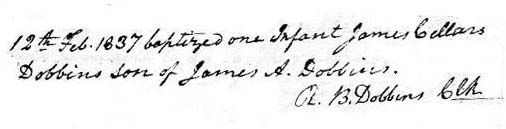
In 1835 Rev. Robert Dobbins bought acreage in Fulton County, Illinois, and he and his now-mostly married children moved there. Rev. Dobbins retired from the circuit riding but he established a local Presbyterian church, composed mostly of his own family members, and in 1837 the church records show that Jim's youngest son, James Sellers Dobbins, was baptised by his own grandfather, the Rev. R. B. Dobbins.
Those same records indicate that at two different times Jim asked for and received a request to remove the family from the church in good standing. The first time was in this same year (1837) and they were gone for four years before returning. In 1851 Jim's oldest son died. In 1856 Jim asked for and received a letter of dismission again; this was after the old Rev. died, and I'd guess Jim now felt free of the burden required of the oldest child. He took his family, just as his own father had, and traveled west, settling in the tiny town of Prairie City in Kansas, just a tinch southwest of Lawrence. No sooner did he get established there than his wife died, his oldest daughter died in childbirth, his second daughter married and headed east with her husband, and his youngest son associated himself, by his own admission, with old John Brown.

It is at this point that James Alexander Dobbins pretty much disappears off my screen. Many of the Douglas County records are missing because of all the problems that area had during the early settlement of Kansas, but it was in one recorded deed in the Douglas County Deed book that I was able to find him again. In 1871 he sold property he owned in Lawrence to the leaders of the Presbyterian Church and the deed showed he was in Maineville, Warren County, Ohio; the deed also showed he had a wife named Eliza Dobbins. A subsequent check of the marriage record showed that he had, in 1861, married the widow Eliza Gant.

Jim died in 1873. I know absolutely nothing of those final years. I have always had the feeling that this fellow, my great-great grandfather, did not have such a happy life. Too many deaths. Too many burdens. And I have always hoped that he found happiness with Eliza; nothing would make me happier than finding an obituary that said so -- but he is as remote at the end of his life as he was during it.

The one thing I have always treasured is a hand-written family chart that was sent to me many years ago by a distant relative I found back in Illinois. It is dated 1922 and is the only record I have that places James Alexander Dobbins in with the rest of the Robert B. Dobbins kids. It's not the kind of proof I would like, but I do believe it to be factual. This fancy chart was drawn then from a simple chart that had been generated at the 1911 reunion; on the older one, James Dobbins was called "Jim." So I've always felt confident that I could put my finger on the name "James" and say "He's mine!" And because of the picture, know what he looked like.