Monday, August 1, 2011

JESSIE CLEONIA DAVIS RYLAND 1885 - 1947

~ RYLAND FAMILY ~


I didn't have either of my grandmas in my life for very long. My dad's mother, who lived in Colorado, died when I was 6, and this grandma, my mom's mother, died when I was 11. But this is how I remember her looking: very grandmotherly, I thought. She was 62 when she died, and I am now 76 and I don't think I look nearly as grandmotherly! But perhaps my own little grandchildren think so. It's hard to see oneself as old.
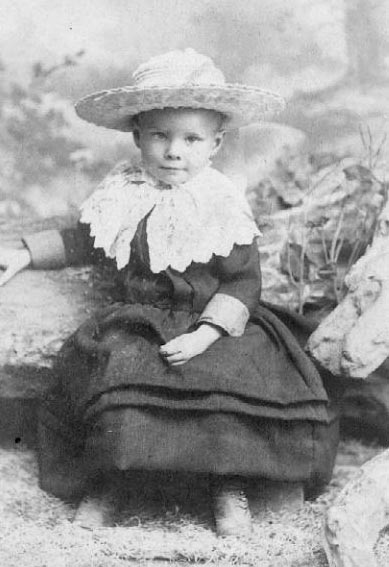
Jessie did not have the easiest of lives. Her father, Joseph Clinton Davis, deserted her mother, Nellie Stevens Davis, shortly after Jessie was born in Kansas. In 1887 her mother met James Eungard, a railroad man, and after securing a divorce, Jim and Nellie moved to Pueblo, Colorado, where they married. Sometime before this picture was taken Jessie took sick with typhoid fever and she lost all her hair. This photo has been in our family for many years and I was told that Jessie's hat covered her bald head.


As with many railroad families, the Eungard family moved from place to place, sometimes in Kansas and at least once to Oklahoma, where her stepbrother Chester Eungard was born. In 1900 the Eungard family was enumerated in Wichita, where Jessie was shown as 15 years old. By 1905, the family was in Caldwell, Kansas, where she met and married Byrd Worthington Ryland, the youngest son of James A. Ryland. In 1906 her first child, a son named Nevalyn Eugene Ryland (called Bob) was born.


She and Byrd would go on to have 6 more children besides Bob: Florence Vivian, Virginia Louise, Marie Eleanor, Byrd Worthington Jr., Hugh Sterling, and Marjorie Ellen.

There was a problem in the marriage, however. Byrd Sr. couldn't settle down. In the course of the marriage he couldn't seem to stay in one place for very long, uprooting the family while he tried to figure out what he wanted to do with his life. He apparently was not in good health and often the move was between Caldwell, Kansas, and Colorado Springs. But there was something else wrong besides that. In 1929 Jessie filed for divorce, in the Complaint noting that "Since the marriage of plaintiff and defendant, defendant has been extremely and repeatedly cruel towards plaintiff..." Later in the papers it notes that "Defendant is not a fit person to have the custody of said minor children." The divorce was granted, and instead of alimony, Jessie accepted a cash settlement and the farm property in Mulvane, Kansas.
By 1929 the three oldest children were out of high school and on their own. Grandma Jessie took the four youngest to the farm and attempted to make a go of it there. I can remember as a child being told that Jessie raised chickens and children, and loved them both. But in the picture below, a snapshot, you can see that life was not easy for her.


To make matters worse, in 1930 the farmhouse caught on fire and burned to the ground. Jessie took the children to her aunt's house in Wichita, where they stayed until she got on her feet again. About this time her son Bob, who had gone to California to become a movie star, encouraged her to come out where he could help her. Grandma asked my mother, who was in Colorado Springs working at a photography studio, to help her with the children on the trip, and in late 1930 they headed to California. I am not sure where in her life the picture below actually belongs, but I like to think that this is how she looked when she began her great California adventure, putting her divorce and her farm loss behind her.


California was in the grips of the depression like the rest of the country, and since Bob's movie career had failed to materialize, the little Ryland group - Jessie, Virginia (19), Marie (15), Bert (11), Hugh (9) and Margie (4) did their best to survive. Jessie used her settlement money to buy a little ice cream shop in North Long Beach, which failed. She then worked at a farmer's roadside vegetable stand, did some odd jobs as a live-in attendent for old people - and my mother took care of all her little siblings. The four younger children always had a very close relationship with my mother, because she was their de facto mother for those really tough depression years.

For many years various family members lived together in Long Beach in a big old house while Bert and Hugh served in WWII. Florence's husband was overseas also, and she and her baby daughter came to California for a while. As things got easier financially for the family, Grandma's cheery disposition took over and in spite of working hard each day, she went dancing at night and certainly must have captured some of her lost fun! She met and became engaged to a fellow dancer and plans were in the making for a wedding when she was felled by a heart attack at age 62 and died.

I have always felt that Grandma Jessie had a tough life. Of course I didn't know much of this when I was a kid, but being raised around all my aunts, uncles and cousins we of course knew some of it. But I will say this for the Ryland Family: None of us second generation kids ever heard a bad word spoken about our Grandpa Byrd. The siblings may have talked among themselves, but they were completely close-mouthed about family matters to their kids. All that I learned about my Grandpa Byrd, who died in 1935 just before I was born, was from my own genealogical research.

Many years later after my own mother died, I asked my dad if he knew what the problem was with Grandpa Byrd. He said my mom never would tell him. But he assured me that for his money, Jessie was the best woman he'd ever met, next to my mom, of course. He said that Jessie cried something awful when she learned that Byrd had died in Colorado. He said he figured she really, after all those years, carried a fondness in her heart for him, the father of all her children.

Monday, July 25, 2011

NELLIE D. SPERRY PERRY JONES - b abt 1862 d ?

~ A DOBBINS FAMILY ~


It is often thought that divorces didn't much happen in "the old days." But people being people, it happened then just as it does now. The record above (which I will "translate" in part below) is found in the Court Records of Lawrence, Douglas County, Kansas, Divorce Packet 5532 and dates to September 9, 1884.

Nellie, daughter of Levi J. and Nancy Anderson Sperry, filed for divorce from her husband, Charles S. Perry. In this petition she says that she married said Perry on October 1, 1879 and was a good, faithful and obedient wife. However, she adds, beginning about May 1, 1884 her husband went to a house of prostitution known as "Moll Butler's" on 3rd Street in Kansas City, Missouri and committed adultery with "a certain woman whose true name is unknown to your petitioner but who is known by the name of 'Blondeyes' and 'Ella' and who is an inmate of said house of ill fame." She adds that he's continued committing adultery with her ever since that time.

She asks the court for a dissolution from the marriage bonds and that she be restored to her maiden name of Nellie D. Sperry. The court granted her request.

I know from further records that she married again, but she is so loosely connected to my Dobbins family that I really haven't spent a lot of time researching her.

Her father, Levi J. Sperry is written about in my blog of April 2011. He was married the first time to Paulina J. Dobbins, who was my great-grandfather Dobbins's sister. Levi, Paulina and a daughter Unitia made the trip west with the Dobbins Family, but Paulina and a newborn baby died in early 1856. Unitia died when she was about 11 years old, so there is no one left in this family related to the Dobbinses. But my great-grandfather remained friends with his former brother-in-law,and in fact was working on Levi's farm when he met his future wife, the widow Nancy "Nannie" Corel LaHay. I have always considered the Sperry family to be emotionally but not biologically connected to the Dobbins line. That's not very good genealogical practice, but sometimes it just happens!

The Sperrys had marriage problems all around. Levi and 2nd wife Nancy had a major divorce scandal. Levi married a third time, and after his death, that wife sued a besotted neighbor for breach of promise.

In genealogy, sometimes you find other people's relatives are far more interesting than your own!

Sunday, July 17, 2011

FRANK EDWARD WHITTERS - 1884-1933

~ A Ryland Relative ~


Is it important to document the existence of a person who is (or was) your half-first cousin twice removed? Or to document a person whose only extant image appears on two passport applications in the National Archives, one dated 9 June 1919 and the other 30 August 1924?

In the scheme of things it may not be all that important, but since starting genealogical research in 1984 I had tried to find this fellow and it took until August of 2010 to find him - 36 years! That makes it important to me.

NOTE: You can double-click the photo above to see the Application more clearly.

Let me see if I can simplify how we relate: My great-grandma Nellie Stevens Davis Eungard (a twice-married lady) and Frank's father, Edward Whitters, were siblings. Their mom, Ellen, had two marriages. Little Frank Whittiers was from the first marriage (his natural father died young) and Nellie Stevens was from her second marriage.

Nellie's daughter Jessie (my grandma) and Frank Whitters were first cousins, both born and raised in Kansas. As far as I can find, Frank never married or had children. So here's how all the "halves" and "removeds" are figured.

Jessie and Frank were half-first cousins.
Jessie's daughter Virginia (my mom) and Frank were half-first cousins once removed. This means that Virginia was still a first cousin but just one generation further down the line.
And because I am Virginia's daughter, I am still a first half-cousin but twice removed. I'm two generations down the line.

Frank was born on April 9, 1884 in Raymond, Rice County, Kansas. In September of 1918 he registered for the WWI Draft and at that time stated his occupation was a farm laborer on his brother-in-law's farm in Kansas. (Frank had a married sister Jenny Whitters Caywood). He may already have done some work in the oil fields, but I have no proof of that. I imagine in between jobs he helped on the farm.

There is an interesting Affidavit in his 1919 Passport Application from his father that sheds some light on his background. It says:
I, E. R. Whitters, being first duly sworn, depose and say upon my oath that I am the father of Frank Edward Whitters, who was born April 9, 1884, at Raymond, Kansas; and that the attending physician was Dr. Burton of Raymond, Kansas; I was born on July 1st, 1854 at Boston, Massachusetts, and that the mother of said Frank Edward Whitters was also a native born American. All of the above mentioned places are in the United States of American.

Other interesting items on his passport are that the passport was to be sent to hm in care of Empire Refining Co., in Ponca City, Oklahoma. His plans were to leave from Laredo Texas on board the Southern Pacific Rail Road on June 20, 1919. A letter from the Anglo Mexican Petroleum Company Ltd. was also included which said he had been engaged by them for a three year period on a salary basis and will be engaged in drilling for Oil in the vicinity of Tampico, Mexico.

We also know that his passport was renewed in 1924.

In 1930 Frank lived in Newton County, Missouri and was listed on the census as a well driller. But in the Thursday, August 24, 1933 edition of the Alice (Texas) Echo News there is a notice as follows:

DRILLER DIES
The Body of Frank E. Whittier (sic), 49, is being held at the Moyer Mortuary, pending instructions from relatives as to where the body is to be shipped. Whittier was a driller for the T. G. & M. Drilling Company and had been employed in the Freer Oil Fields."
There was no further information in the newspapers, but Charles Roberson of Roberson's Funeral Home in Alice, Texas was able to tell me that he checked with the Alice Cemetery and found that Frank E. Whitters was buried in Section D, Lot 6, Space 6. The death certificate was issued in Duval County, Texas. An autopsy was perform which indicated angina pectoris, coronary occlusion and arterio sclerosis.

So Frank had a short life. But at least he is now counted among my other relatives, the Immortal Nobodies, and can be found again, should anyone else be looking.

Saturday, July 2, 2011

UBERTO WRIGHT - 1813-1889

~ A DOBBINS FAMILY ~


No family pictures exist of Uberto Wright or his second wife Susannah Jane Smith Wright, from whom I descend. His first wife, Sarah Allen, died young, leaving two small daughters (Miriam and America.) Uberto and Susan had six children: Frances Narcissa, called Fannie, James, John, Jacob, Minerva and Lily. Fannie was my great-grandmother on my dad's side.

You would think a diligent researcher would find some kind of explanation as to where such an usual name as Uberto came from. But no, in 27 years of researching I have not found an earlier source. I have found descendants with that name, along with themes and variations: Ulberto, Uberdo, Alberto, Alberta, Huberto and so on. I've decided people want to understand the name by making it be something else. But it is, plain and simple: Uberto.

Uberto was born in Barren County, Kentucky in January of 1813 and was reared principally in Warren County, which borders Barren on the west. He was a farmer and did surveying. He also became a minister in the Christian Church (aka Church or Christ or Campbellite) and in the 1880s he was employed by the State Board of the Christian Church as an evangelist. He also served as Justice of the Peace several times. He was called on to become a candidate for the Legislature but he refused, not being interested in things political. He had a plantation of some 255 acres on Peter's Creek in Barren County. He was a slaveholder prior to the Civil War.

The 1870 Federal Census for Barren County, KY is quite interesting as it pertains to our Wright family. Take a look at it. The slaves have been emancipated. The first column counts houses and the second number counts family. So you see first Uberto and Susan's household and then you see Felix and America Wright's family.


In the Uberto & Susan Wright family we find James, Jacob, John, Lilly and Polly, Uberto's sister. The three oldest daughters, Mary Ann, America and Narcissa are already married and living on their own. I do not know who Sallie Vaughn is, but there are also three black Wrights: Malinda, a maid; Rufus a farm hand,and Fannie, a child. In the house next door we find another family of Wrights - Felix and America, with children Samuel, Uberto, Luther, Sera?, and Zack.

You can see the names "America" "Fannie" and Uberto appear in both famlies. And my great-grandma Fannie Wright McConnell named one of her sons "Luther."

Narcissa (the oldest child of Uberto and Susannah) was my father's grandma. She and her husband left Kentucky about 1880 and went to Texas and then to Colorado. My father and his sister (my Aunt Dorothy), who were born and raised in Colorado, knew their grandma, who was called "Bonnie." When I started into genealogy my questions spurred Aunt Dorothy to write a Family History of what she remembered about her family. Here is one sentence in her story that pertains to the Uberto & Susannah Wright family:

The family (Narcissa and husband) moved to Waco, Texas in 1880, living on a small farm. Mama said one of the former slaves from the Wright plantation came with them. Many stayed on after the war ended and were treated as members of the family.
The picture of the family as shown in the 1870 census gives a hint that Aunt Dorothy's recollection just may be right.

All my reading about Uberto leads me to believe he was a kind Christian man. I would guess (and hope) that he treated his slaves well and was first in line to give them their freedom when the time came. I also would suspect that my Aunt Dorothy was right in what she remembered and the now-freed slaves chose to remain close to Uberto and Susan.

Another plus for Uberto is that he gave his wife "power and authority at his demise to make sales of land and deed by general warranty, the same to the purchaser or purchasers to have the full force of a deed from myself and her jointly, and any other small matter than I might or may owe that my wife pay the same as in her judgment may be deemed proper." I was pleased that he gave his wife credit for having some brains!

And finally, his last words in his will were these: "May God bless my family." A will rattling around with family skeletons is fun to read, but how much better to read one that contains a blessing!

Uberto died in 1889 and Susannah Smith Wright in 1903. They are buried in the Smith Cemetery (near Etoile) in Barren County. With them are their children, John C. Wright and Minerva Wright, as well as Susan's father and mother, James D and Rebecca D. Higdon Smith.

Wednesday, June 22, 2011

MADDENS - CO. CORK TO MASSACHUSETTS TO ILLLINOIS

~ A Ryland Family ~


It is a lucky day for a genealogist when the tombstone carries magical information.

Here is what my third-great grandfather's stone says:
Sacred to the Memory of Stephen Madden
Died May 28, 1877, aged 75 years
Born in the Parish of Kilbragen
Town of Bandon, Co. Cork, Ireland.

And his wife's says:
Sacred to the Memory of
Hanorah
Wife of Stephen Madden
Died August 23, 1870 age 72 years 3 mo.
Born in the Parish of Kilbragen
Town of Bandon, Co. Cork, Ireland

And the following inscription is on both of them:
When the hours of life are past
And death's dark shades arrives at last,
It is not sleep, it is no rest,
'Tis Glory opening to blest.
N. Imus


These stones are in the Madden plot at Holy Cross Cemetery in Mendota, Illinois.

Stephen and Hanorah (found sometimes as Honorah, and occasionally shown as "Nora") arrived in the United States sometime between June of 1830 and July of 1834. They brought three children with them: Julia, b 1825; Timothy b abt 1828; and John C., b 10 June 1830. Settling in Taunton, Massachusetts, their last child, Ellen, was born there on 10 July 1834. She was my second-great grandmother.

On the 1850 census records Stephen is shown as a "laborer." By this time son Timothy had gone to California (and was never heard from again,) and daughter Julia had married Peter Donohue. In 1853 the records in St. Mary's Church show that son John had married Mary Sullivan and Ellen had married Robert Whitters, a young man from Ireland. Unfortunately Robert died in 1855, leaving Ellen a young widow with Edward, a year-old child.

All the Madden family except for Ellen moved to Mendota, LaSalle County, Illinois in 1853. But after her husband's death she took Edward and followed her family. It was there that she met and married Chester Stevens in 1857. Edward Whitters retained his birth name but was raised in the Stevens family as the oldest son.

Stephen and Hannorah were devout Catholics and were not too pleased at their daughter Ellen marrying outside the faith, according to a letter in the possession of granddaughter Lucile G. Fulton York in 1969. Written to a grandson of Julia Madden Donohue, these are the salient parts:

My Grandmother, Ellen, was, I think, the only member of her family born in this country. She married Robert Whitters and they had a son before he was killed, leaving her a young widow with a baby son....I think, but am not sure, that Grandfather [Chester]Stevens was in the same business as Uncle Pete and was selling machinery - traveling around. Grandfather was from English parents and Steven's Point, Wisconsin is named that because they founded the town. When they were married, Grandfather and Grandmother migrated to Raymond, Kansas.

The reason our branch of the family knows little about Grandma's people is that Grandfather was not Catholic and her people were displeased. He died around the turn of the century so I didn't know him. His sister, Sophronia, married Gen. Steven Hurlbut and he and Grandma were frequent visitors at the White House after Grant became President. Grandma was a great gal, walked like a queen, and had a combination of Irish and Bostonion accent that was really something....I have a remnant of a paisley shawl, which was a wedding gift and which I am putting in small antique frames for the grandchildren, along with the records I have...."
Nothing more is known about Steven and Hanorah

Sunday, June 5, 2011

THESE ARE THE FACES OF GENEALOGY


A recent picture posted on LA Weekly purported to be the face of genealogy, but it was a less than flattering picture of two young boys. Frankly, it was a tasteless illustration and whoever chose that picture was no friend of genealogists.

I offer here my take on the face of genealogy - my Uncle Bob Ryland and my Aunt Florence Ryland, sitting for the photographer in Caldwell, Kansas in 1908. This Ryland line goes back to Paulus Reylandt - who died in Berks, PA in 1789.

Thursday, June 2, 2011

ROBERT GASTON DOBBINS - 1828-1851

~ A DOBBINS RELATIVE ~

I am always afraid that relatives who die either young or at least before they marry and start a family will get lost both in the memory and in the record. Robert Gaston Dobbins was my great-grandfather's brother. He died when he was only 23 years old and unmarried. Although my great-grandfather named his first son after him, (Robert Gaston Dobbins 1872-1929) by the time I started genealogy in 1984 no one in the family had any inkling that there had been an earlier relative by that name. I am hoping that my record of him will here always be available to anyone running a search on that name. He is truly an Immortal Nobody.

Robert Gaston Dobbins had been born in Clermont County, Ohio to James "Jim" Alexander and Elizabeth Perkins Dobbins. In 1834 the Dobbins family, headed by the Rev. Robert B. Dobbins, a circuit-riding Presbyterian Minister, left Ohio for Illinois, where Rev. Dobbins had purchased enough land to ultimately deed some to each of his children. The family settled in Vermont Township, Fulton County, Illinois.

The Mississippi River is the western border of Illinois
and many rivers feed into it. The dot on the map below shows approximately where the Dobbinses settled and you can see the waterways that course through it. The two biggest are the Illinois River and nearer to Fulton County the Spoon River.


My friend Carl Peterson, a retired history professor, a superb genealogist and a terrific social historian, told me that the Mississippi Valley, of which west-central Illinois is a part, had a terrible cholera epidemic in 1851, and it is possible that this is what Robert died from. Of course we don't know for sure. We do, however, know that it was from an illness, as one of the charges against his estate was a bill from the doctor that read: “To P. S. Secor, Dr. For 20 visits, advice and medicine per self in last illness - $33.25,” Carl noted that is is unlikely that someone dying in a cholera epidemic would have had occasion for 20 visits to the doctor.

What we do know is that Robert did not leave a will, but he had enough assets that his estate had to be probated. Robert's father Jim was the administrator and he had to declare all of Robert’s assets and all of his liabilities.


Although this record is difficult to read, Robert apparently loaned money to Levi J. Sperry, who was married to Robert’s sister Paulina Jane; Robert was holding two notes, one for $20 and the other for $12.50. As administrator of the estate Jim noted that it was “doubtful” that these were collectible. I suspect that this was a way to “forgive” the notes. After all, Levi was his son-in-law, and what father hasn’t helped out his kids? The husband of daughter Elizabeth Dobbins Kinsey owed seventy-five cents, but Jim didn’t “forgive” that debt. (Claudius Kinsey had deserted Elizabeth some years earlier). And Jim himself owed $8.87, which he said he was good for. The total money outstanding was $78.57.

Among the bills that Robert’s estate incurred was one for $8.00 from Thomas Grewell for making the coffin and one for $2.00 paid to John Marshall “for crying Sale of the Estate of said deed.” “Crying” is a word used when there is an auction or sale – the auctioneer “cries” the sale.

An inventory was taken of all Robert’s possessions, and among the items on the list were some fairly uncommon items for a young man who lived on a farm on the Illinois prairie:

1 leather trunk
1 silk plush cap
1 pair pantaloons
1 satin vest
2 silk neck handkerchiefs
1 pr hose
1 mole skin hat
1 fine shirt
2 pair cashmere pants
1 gold ring
1 umbrella
1 Missouri Harmony

Of course there were the usual undershirts, underpants, jackets, hats, etc. that you would expect. All the inventoried items were sold at auction. Purchasers included family members and a few neighbors.

I originally thought a “Missouri Harmony” was a harmonica. But I learned that it was a shape-note singing book that had been used since the 1820s in the various singing schools that were held in many areas during that period of our country’s history. They were created for people who didn’t read music; singers could identify the tune by observing the shapes of the notes. Sometimes they are called “wheat notes.” There also was another book that was popular at that time called “Sacred Harp.”

In my investigation to learn about the Missouri Harmony, I was able to purchase a reproduction from the University of Nebraska book store for $1.00 – a closeout price. They had one copy left, obviously waiting for me! Here’s what it looks like.


I know nothing more about young Robert Gaston Dobbins except that he was buried in the Dobbins Cemetery in Vermont Township, Fulton County, Illinois. No picture exists.